---
title: "Quick Commerce: The Complete Guide to Ultra-Fast Delivery Business ([year])"
url: "https://demo.upperinc.com/blog/quick-commerce/"
date: "2024-02-02T05:16:22+00:00"
modified: "2026-03-17T00:00:00+00:00"
author: "Rakesh Patel"
categories: ["Blogs", "eCommerce"]
word_count: 1257
reading_time: "7 min read"
summary: "This blog elaborates on the concept of Q commerce and how it differs from conventional eCommerce. It also explains the steps to create your eCommerce store and strategies to make it successful. Lea..."
description: "Discover what quick commerce is, how it works, and why businesses use ultra-fast delivery. Complete guide with market stats, benefits & implementation tips."
keywords: "Quick Commerce, Blogs, eCommerce"
language: "en"
schema_type: "Article"
related_posts:
- title: "Modern Delivery Issues: What They Are & Strategies to Overcome Them"
url: "https://demo.upperinc.com/blog/delivery-issues/"
- title: "A Comprehensive Guide on What Is Vehicle Idling"
url: "https://demo.upperinc.com/blog/what-is-vehicle-idling/"
- title: "ETA vs ETD: Complete Guide to Estimated Time of Arrival & Departure (2026)"
url: "https://demo.upperinc.com/blog/what-is-eta-etd/"
---
# Quick Commerce: The Complete Guide to Ultra-Fast Delivery Business ([year])
_Published: February 2, 2024_
_Author: Rakesh Patel_
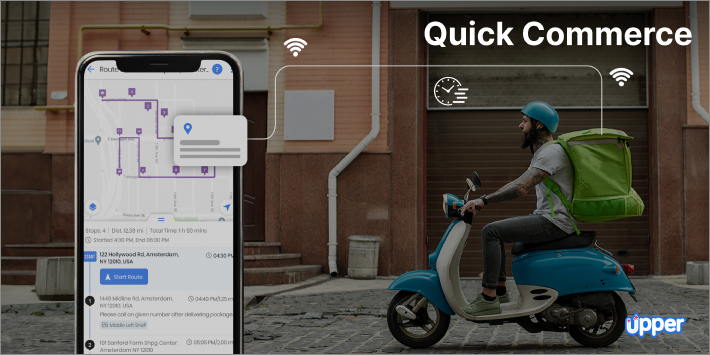
> This blog elaborates on the concept of Q commerce and how it differs from conventional eCommerce. It also explains the steps to create your eCommerce store and strategies to make it successful. Learn more!
The evolution from “I’ll pick it up tomorrow” to “I need it in the next hour” represents more than changing consumer expectations.
It signals a fundamental shift in how commerce operates.
The word quick commerce emerged from the intersection of three powerful forces: urban density, smartphone ubiquity, and the pandemic-accelerated demand for contactless convenience.
The quick commerce market delivers products within 15-60 minutes through strategically located micro-warehouses and optimized delivery routes.
Unlike traditional e-commerce focused on selection and price, q commerce prioritizes speed and immediacy above all else. With the global market projected to reach [$337.59 billion](https://www.fortunebusinessinsights.com/quick-commerce-market-111868) by 2032, understanding this model isn’t just about staying current—it’s about recognizing the future of retail delivery.
Table of Contents
- [What is Quick Commerce?](#what-is-quick-commerce)
- [Quick Commerce vs Traditional E-Commerce: Key Differences](#quick-commerce-vs-traditional-e-commerce-key-differences)
- [How Quick Commerce Operations Work?](#how-quick-commerce-operations-work)
- [Global Market Landscape & Major Players](#global-market-landscape-major-players)
- [Technology Infrastructure & Dark Stores](#technology-infrastructure-dark-stores)
- [Benefits & Implementation Challenges](#benefits-implementation-challenges)
- [Implementation Guide & Success Metrics](#implementation-guide-success-metrics)
- [Future Trends & Technology Evolution](#future-trends-technology-evolution)
- [Conclusion: Quick Commerce Success Factors](#conclusion-quick-commerce-success-factors)
## What is Quick Commerce?
Quick commerce is an ultra-fast retail delivery model that fulfills orders within 15 minutes to 1 hour of placement.
This model primarily serves immediate needs rather than planned purchases, expanding the food delivery concept to virtually any product category.
### Alternative terms include:
• **Q-commerce** (most common abbreviation)
• **Instant commerce** (emphasizing immediate delivery)
• **Fast commerce** (highlighting speed advantage)
• **On-demand delivery** (focusing on customer-initiated fulfillment)
## Quick Commerce vs Traditional E-Commerce: Key Differences
Understanding the fundamental differences helps businesses choose the right approach:
### Quick commerce characteristics:
• **Delivery Speed:** 15 minutes – 1 hour
• **Order Types:** Immediate needs, small quantities
• **Inventory:** 2,000-4,000 SKUs (curated selection)
• **Infrastructure:** Dark stores, micro-fulfillment centers
• **Service Area:** 3km radius per location
• **Vehicles:** Bikes, scooters, on-foot delivery
• **Pricing:** Premium for convenience (15-25% markup)
### Traditional e-commerce characteristics:
• **Delivery Speed:** 3-7 days (1-2 days expedited)
• **Order Types:** Planned purchases, bulk orders
• **Inventory:** Unlimited comprehensive selection
• **Infrastructure:** Large warehouses, distribution centers
• **Service Area:** Regional/national coverage
• **Vehicles:** Trucks, vans, air freight
• **Pricing:** Volume discounts, competitive rates
### When to choose quick commerce?:
• Emergency purchases (medicine, baby supplies)
• Last-minute needs (party supplies, ingredients)
• Convenience-driven shopping (busy professionals)
• Impulse purchases (snacks, beverages)
## How Quick Commerce Operations Work?
Quick commerce operates through a precisely orchestrated five-step process:
### 1. Order processing
Customer places the order through the mobile app with real-time inventory verification and payment processing. The system routes orders to the optimal fulfillment location based on proximity and availability.
### 2. Dark store fulfillment
[Order Management Systems](https://demo.upperinc.com/blog/order-management-software/) assign items to the nearest dark store. AI-optimized picking routes minimize walking time within facilities, while quality control ensures product condition and appropriate packaging.
### 3. Route optimization & dispatch
Route optimization calculates optimal delivery sequences considering driver location, traffic patterns, and capacity. Dynamic assignment ensures efficient multi-order routes with real-time adjustments.
### 4. Last-mile delivery
GPS tracking provides real-time updates with direct customer communication channels. Contactless delivery options include photo confirmation and exception handling for failed attempts.
### 5. Performance monitoring
Continuous tracking of delivery times, customer satisfaction, route efficiency, and inventory turnover enables ongoing optimization and strategic improvements.
## Global Market Landscape & Major Players
The quick commerce sector represents one of the fastest-growing segments in retail technology, with significant regional variations:
### Market size & projections:
• **Global Market Value (2024):** [$170.80 billion](https://www.fortunebusinessinsights.com/quick-commerce-market-111868)
• **Projected Value (2032):** $337.59 billion
• **Growth Rate (CAGR):** 9.01%
### Leading players by region:
#### North America
- **Gopuff:** [$15B valuation](https://www.businessofapps.com/data/gopuff-statistics/#:~:text=Source%3A%20Appfigures-,Gopuff%20Valuation,to%20%2415%20billion%20in%202021.), 500 cities, owned dark stores
- **Instacart:** Public company (NASDAQ: CART), marketplace model
- **Amazon Fresh:** Integrated Prime ecosystem
#### Europe
- **Getir:** [$12B valuation](https://www.businesswire.com/news/home/20231215050549/en/Getir-Completes-the-Acquisition-of-Leading-US-Online-Grocer-FreshDirect), acquired Gorillas and FreshDirect in 2023
- **Glovo:** [$528M](https://tracxn.com/d/companies/glovo/__-2D9UfkDSWBfX0LNRAy7wkKbf3t2P_7oH-o1tHwmkzI/funding-and-investors) Series F funding, 25-country presence
- **Deliveroo:** Public company expanding grocery services
#### Asia-Pacific
- **Grab:** Super-app model with GrabMart integration
- **Swiggy Instamart:** Food delivery platform expansion
- **Meituan:** Dominant Chinese market leader
### Customer demographics:
Primary users are ages 25-40 (68% of orders) with $50,000+ household income in metropolitan areas. Average order frequency is 2-4 times monthly with $25-45 order values across markets.
## Technology Infrastructure & Dark Stores
Successful quick commerce depends on sophisticated technology integration and strategically located fulfillment centers.
### Dark store specifications:
• **Size:** 300-700 square meters optimized for picking efficiency
• **Capacity:** 1,000-3,000 unique products (SKUs)
• **Location:** Within 3km of target customers
• **Operations:** 24/7 capability with flexible staffing
• **Technology:** Real-time inventory tracking and automated reordering
### Essential technology components:
#### Core Systems:
- Order Management System (OMS) with multi-store inventory synchronization
- Mobile applications for customers, drivers, and warehouse staff
- Route optimization platform with traffic integration
- Payment processing with fraud protection
#### Integration Requirements:
- Inventory management APIs with supplier systems
- Mapping services (Google Maps, Mapbox) for routing
- Analytics platforms for performance monitoring
- Customer communication tools (SMS, email, push notifications)
## Benefits & Implementation Challenges
### Strategic advantages:
#### Customer Benefits:
- **Ultra-fast fulfillment:** 25-35 minute average delivery
- **High reliability:** 85-95% on-time delivery rates
- **24/7 availability** in major markets
- **Emergency access** to critical items
#### Business Benefits:
- **Premium pricing power:** 15-25% markup acceptance
- **Customer loyalty:** High switching costs once habits form
- **Operational efficiency:** Lower real estate costs than traditional retail
- **Data insights:** Predictable demand patterns for optimization
### Key challenges:
#### Profitability Pressures:
- Average order values ($25-45) vs. delivery costs ($8-12)
- Customer acquisition costs ($50-150 per user)
- Dark store setup costs ($100,000-500,000 per location)
- Labor costs representing 40-50% of revenue
#### Operational Complexities:
- **Weather impact:** 60% delivery time increase during severe conditions
- Urban infrastructure limitations affecting vehicle access
- Quality control across temperature zones and rapid fulfillment
- Regulatory compliance varies by city and product category
## Implementation Guide & Success Metrics
### Launch phases:
### Phase 1 – Market Research (Weeks 1-4):
- Target demographic analysis and competitive mapping
- Financial modeling with $500K-2M initial investment requirements
- Location selection based on population density and accessibility
### Phase 2 – Infrastructure (Weeks 5-12):
- Dark store setup with technology integration
- Supplier partnerships and inventory system implementation
- Staff hiring and comprehensive training programs
### Phase 3 – Operational Launch (Weeks 13-16):
- Soft launch with limited geographic testing
- Marketing campaigns and customer acquisition initiatives
- Performance optimization and financial tracking
### Critical success metrics:
#### Delivery Performance:
- **Average delivery time:** Target 25-35 minutes
- **On-time delivery rate:** Target 90%+ within promised windows
- **Order accuracy:** Target 98%+ correct items delivered
- **First attempt success:** Target 95%+ completion rate
#### Financial Benchmarks:
• **Gross margin:** Target 40-60% after product costs
• **Customer acquisition cost:** Target $50-150 per new customer
• **Break-even timeline:** 12-18 months per location
• **Customer retention:** 60-80% repeat rate within 3 months
## Future Trends & Technology Evolution
### Technology roadmap 2025-2030:
#### Near-term (2025-2026):
- AI-powered demand forecasting reduces waste by 30%
- Advanced route optimization achieving 25% efficiency gains
- Automated picking systems in high-volume locations
- Enhanced chatbot customer service capabilities
#### Medium-term (2027-2028):
- Drone delivery pilots for lightweight suburban items
- Autonomous vehicle testing in controlled environments
- Robot delivery for apartment complexes and office buildings
- Smart city infrastructure integration
#### Long-term (2029-2030):
- Fully automated dark stores with minimal human intervention
- Widespread autonomous delivery adoption
- IoT-enabled smart packaging with real-time monitoring
- Augmented reality customer experience integration
### Market evolution predictions:
The industry will likely see consolidation into 3-5 dominant global platforms by 2030, with traditional retailers acquiring quick commerce startups and technology providers becoming prime acquisition targets.
## Conclusion: Quick Commerce Success Factors
**Quick commerce** represents a fundamental shift toward instant gratification in digital commerce.
Success requires mastering the complex interplay of technology, logistics, and customer experience while maintaining strict financial discipline.
### Essential success elements:
• **Operational excellence:** Strategic dark store placement and sub-30-minute fulfillment
• **Technology leadership:** AI-powered forecasting and mobile-first customer experience
• **Financial management:** Unit economics achieving profitability within 18 months
• **Route optimization:** Intelligent delivery planning reduces costs by 30%
As route optimization specialists, Upper understands that delivery efficiency determines quick commerce profitability.
Our [software solutions to optimize delivery routes](https://demo.upperinc.com/) help businesses reduce delivery costs, improve on-time rates, and scale operations efficiently. across multiple dark store locations.
Whether planning a quick commerce launch or optimizing existing operations, strategic route planning provides the foundation for sustainable growth.
Contact Upper today for a personalized demo of our route optimization platform designed specifically for quick commerce operations.
---
_View the original post at: [https://demo.upperinc.com/blog/quick-commerce/](https://demo.upperinc.com/blog/quick-commerce/)_
_Served as markdown by [Third Audience](https://github.com/third-audience) v3.4.7_
_Generated: 2026-03-17 12:08:31 UTC_