Charge Ahead with the #1 EV Route Planner

What Is an EV Route Planner?
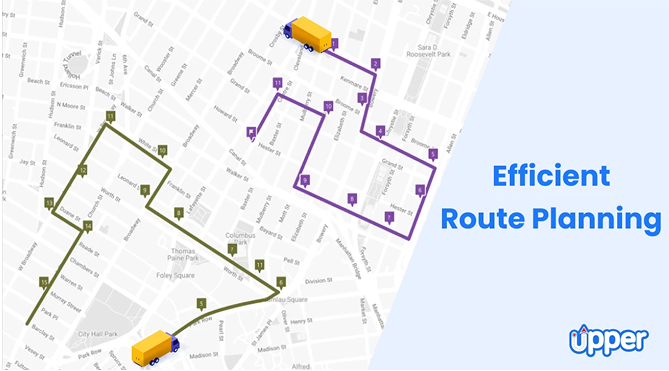
An EV route planner is a software solution that helps create the most optimal routes for your fleet of electric vehicles.
Here’s how it works: An EV route planner helps plan routes based on factors such as the vehicle’s battery capacity, current state-of-charge, charger locations, and estimated plug-in times. It also accounts for live traffic, delivery time windows, and terrain elevation during routing.
Upper’s EV route planner helps you simplify your routing operations for all your electric vehicles centrally and efficiently.
Features That Simplify Your EV Routing
Manual EV route planning can be a headache, and we understand that! You have to juggle battery limits, charging stops, delivery schedules, live traffic, and multiple drivers all at once.
Worry not, as Upper has the features to ease your work and make every EV trip hassle-free.
- Charge station optimization
- Battery range & consumption forecasts
- Dynamic route adjustments
- Driver app
- Energy consumption monitoring
- Precise geocoding
- Constraint-based scheduling
- AI-driven smart route suggestions
- Real-time task allocation

With Upper, you can create routes that avoid tolls, highways, road closures, one-way streets, or congested urban areas. Our system lets you configure vehicles’ capacity specifics to ensure cargo doesn’t exceed the capacity constraints of vehicles’ routes.

See it in action
Simplify EV Routing, Eliminate Range Anxiety
Enjoy seamless multi-stop trips, dynamic adjustments, and precise range forecasts with Upper's comprehensive EV planner.

Proven Performance: Upper by the Numbers
Don’t Trust Us? Let Numbers Do the Talking!
30%
fewer
charging stops
25%
less total
charging time
40%
boost in driver
productivity
Top Benefits You Can
Get From EV Routing Solutions

Easier multi-stop trips
Upper plans routes considering all your delivery addresses, trip duration, and charge stops. It helps your drivers drive smoothly between stops with no range anxiety.

Extended driving range
Power-usage forecasts show energy needs per leg. It helps you plan charging breaks so your vehicle doesn’t run out of charge mid-way.

Reduced charging downtime
Charging station availability data helps you schedule your charging breaks to minimize wait times and maximize driving hours.

Reliable on-time job completion
Instant rerouting based on traffic, congestion, or road closures helps increase on-time delivery rates.

Customer satisfaction
Upper factors in traffic, congestion, and charge times to determine and convey precise ETAs to customers. It reduces inbound order status calls and builds trust and loyalty.

Smarter resource utilization
Upper dynamically reallocates deliveries based on real-time vehicle range and charger access. This helps avoid vehicle under-/overutilization.
Proven Performance: Upper by the Numbers

Right in the middle of rush hour on the Williamsburg Bridge, Upper’s dynamic rerouting kicked in and steered us around the backup. We still hit every drop-off on time.
Integrations That
Enhance Your EV Routing
Upper integrates with the most essential tools you need to streamline your HGV routing operations.



What All Should an
EV Route Planner Have?
When choosing EV routing software, here are a few considerations and features you can keep in mind.
-
A limited battery range and unprecedented drain can leave your EVs stuck midway. A good EV route planner should let you map a trip based on real-time state-of-charge and safety buffers so drivers don’t run out of power.

-
Balancing tight delivery windows with charging needs is tricky. Your planner must align customer time slots with battery levels and charge-stop plans to ensure on-time arrivals.

-
Rigid routes that don’t consider terrain or charger access can hamper efficiency. Look for customization capabilities that enable avoiding steep hills, toll roads, or areas with fewer EV charging stations as desired.
-
Traffic jams, road closures, and last-minute orders can impact your EV schedules. Your EV trip planner needs dynamic rerouting that recalculates your route and charging plan to minimize disruptions.


-
If a planned route risks exceeding a vehicle’s range, it can leave your driver stuck mid-way. If your preselected charging station runs out of service, it can also impact your driver’ schedule. So, look for an EV route planner that sends real-time contingency alerts and warnings to keep you informed.

-
Tracking your deliveries is key to staying informed on their progress. An advanced EV trip planner must provide GPS-enabled live tracking so dispatchers can view real-time drivers’ progress.
-
Drivers need to view directions, charge reminders, and document successful deliveries. So, your software should provide a mobile app for drivers to see turn-by-turn navigation directions, receive charge alerts, and capture proof of delivery.
-
You can’t expect to analyze your business performance without detailed data. So, an ideal EV route planner must provide detailed reports on energy consumption, charging costs, and route performance for smart decision-making.


Challenges for EV Drivers
While electric vehicles bring sustainability and cost advantages, EV drivers face unique operational hurdles when on the road.
Let’s look at the most common challenges they face:
- . Range anxiety: Drivers worry about running out of battery with no charger in sight. Upper’s accurate range forecasts and safety buffers help avoid it.
- . Charging infrastructure gaps: Charging stations are not as easily available as gas stations in some areas. Upper pulls data from all major charging networks so drivers have options to pick from.
- . Variable plug-in times: Different stations and battery states vary in the speed at which they charge a vehicle. Upper considers the estimated charge durations to predict precise ETAs and keep schedules realistic.
- . Sudden unforeseen changes: Traffic, road closures, congestion, construction, inclement weather, and charger unavailability can cause disruptions. Upper integrates live feeds on all this data to recalculate routes in real time to avoid them.
- . Driver convenience: Complex data can overwhelm your drivers. Upper’s mobile–first app declutters data and shows drivers only what they need — simple directions, charge alerts, and ETAs.
- . Keep your data handy: Collect all your crucial information, including customers’ locations, delivery distances, vehicle dimensions, and traffic patterns. Consider picking roads with fewer stops, avoiding high-congestion areas, and scheduling journeys during off-peak hours.
Tips to Get the Most from Your EV Routes
- . Use precise location data: Upload exact addresses, distances, and elevation profiles so your forecasts stay accurate.
- . Avoid rush hours: Consider avoiding charging your vehicles during peak demand. Instead, schedule your charging during off-peak hours to minimize wait times.
- . Track battery health proactively: Continuously monitor your battery health using a battery management system. Check for signs of degradation and plan replacement if needed to avoid major issues.
- . Use backup chargers: Keep a portable electric car charger handy, especially during long journeys. If needed, you can also consider buying off-grid EV chargers with integrated batteries as a buffer.
- . Prioritize responsible driving habits: Train drivers on how smooth acceleration and regenerative braking can extend their battery range.
Make Every EV Mile Count
Keep your EV fleet charged and on time with smart routes and a built-in charging estimate in Upper’s unified platform.