
Modern delivery operations generate massive amounts of data every day, from traffic conditions and delivery time windows to driver behavior and customer demand patterns. The challenge for logistics businesses is turning this data into faster, more efficient delivery decisions.
Traditional route planning methods often struggle to adapt to real-time variables, leading to delays, higher fuel costs, and inefficient routes. This is where machine learning route optimization is transforming logistics operations.
By analyzing historical and real-time delivery data, machine learning algorithms can continuously improve route planning decisions, predict delays, optimize delivery sequences, and adapt routes dynamically as conditions change.
As customer expectations for faster and more reliable deliveries continue to rise, businesses are increasingly adopting AI-driven routing technologies to improve efficiency and reduce operational costs. In this guide, we’ll explore what machine learning route optimization is, how it works, its key benefits, and how businesses can use it to build smarter delivery operations.
Table of Contents
- What Is Machine Learning Route Optimization?
- 6 Benefits of Machine Learning Route Optimization
- How to Implement Machine Learning Route Optimization
- 4 Challenges of Machine Learning Route Optimization (and How to Solve Them)
- 6 Best Practices for Machine Learning Route Optimization
- Optimize Your Routes With Upper’s Intelligent Routing Algorithms
- FAQs on Machine Learning-Enabled Route Optimization
What Is Machine Learning Route Optimization?
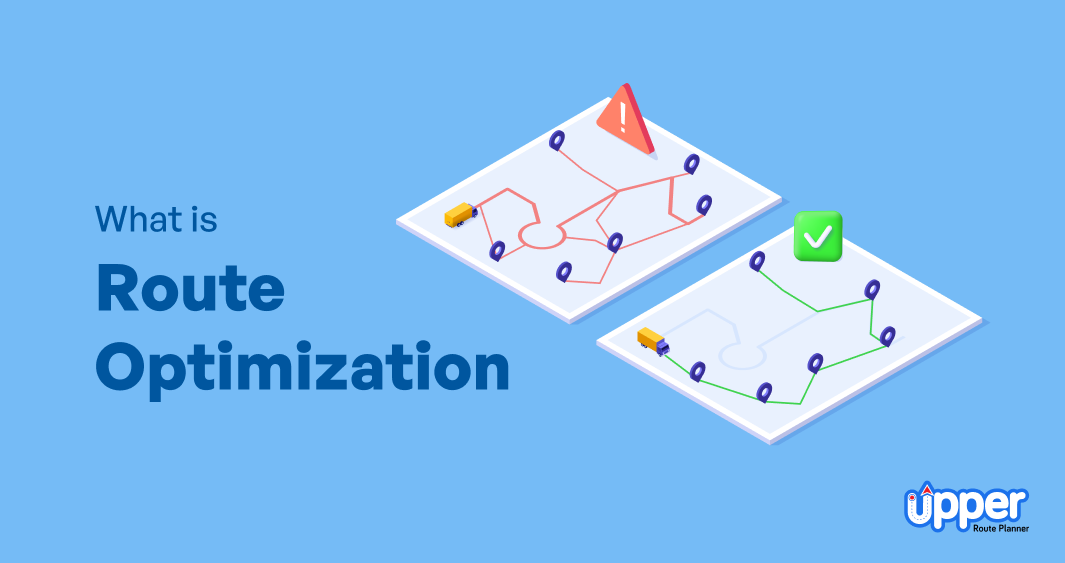
Machine learning route optimization is the application of algorithms that learn from historical and real-time data to calculate the most efficient routes across multiple stops, drivers, and constraints. Unlike traditional optimization, which relies on static distance and time matrices with fixed rules, ML-powered routing continuously refines its predictions based on actual fleet performance data.
For example, a courier fleet running 200 daily stops across 15 drivers might use a rules-based system that calculates routes based on the shortest distance. An ML-powered route optimization algorithm would analyze six months of completion data, learn that certain neighborhoods have longer service times on specific days, predict traffic slowdowns based on historical patterns, and generate routes that account for variables a static system would miss entirely.
How Machine Learning Enhances Route Optimization
ML algorithms bring five core capabilities that traditional routing tools lack:
- Pattern recognition: Learns from thousands of past routes to predict travel times, service durations, and delay probabilities
- Real-time adaptation: Ingests live traffic, weather, and order data to recalculate routes dynamically through dynamic route optimization
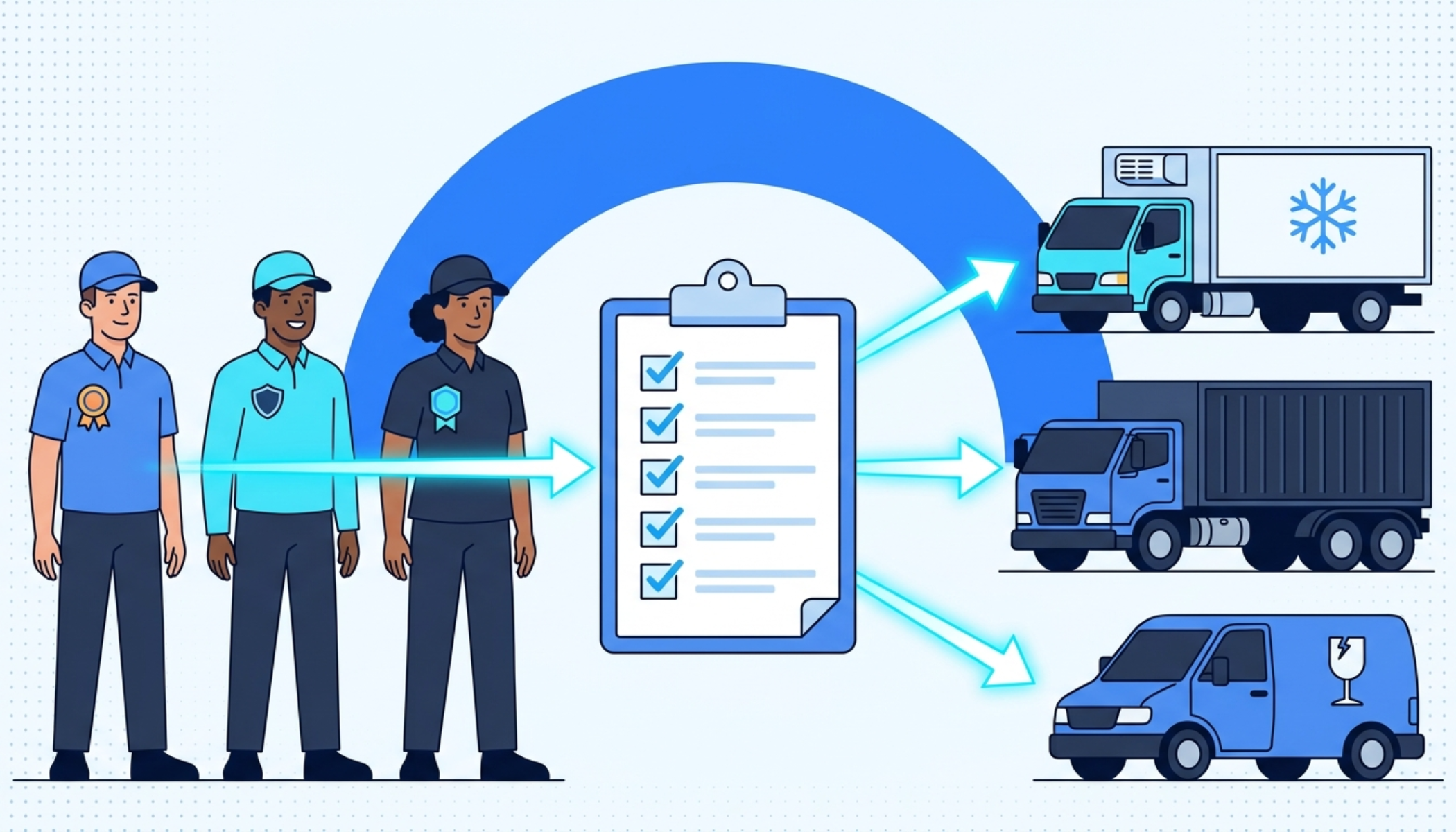
- Constraint handling: Balances vehicle capacity, driver skill sets, time windows, and regulatory requirements simultaneously
- Continuous improvement: Each completed route feeds back into the model, improving accuracy over time
- Predictive capability: Anticipates congestion, failed deliveries, and demand spikes before they occur
6 Benefits of Machine Learning Route Optimization
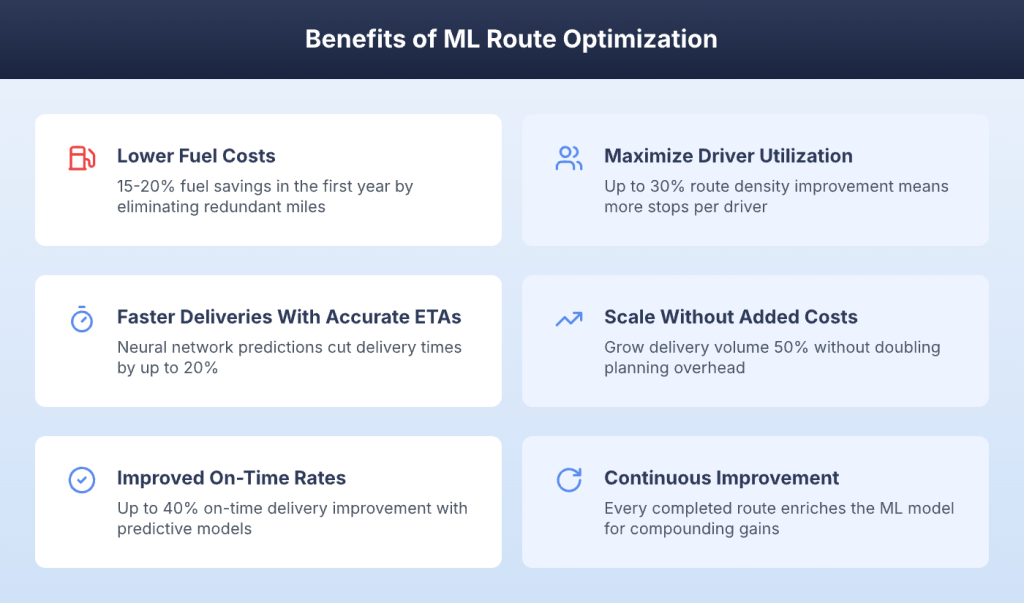
The shift from static to ML-driven routing delivers measurable improvements across cost, speed, and customer experience. Here are six benefits that build the business case for ML-powered routing.
Lower Fuel Costs and Reduce Mileage
ML algorithms calculate routes that minimize unnecessary driving by analyzing traffic patterns, stop density, and historical travel times. Companies using AI-powered routing report 15-20% fuel savings within the first year by eliminating redundant miles and reducing idle time.
For a 20-driver fleet averaging $3,000 per month in fuel, that translates to $5,400-$7,200 in annual savings. This is a classic example of how route optimization reduces fuel costs using smart algorithms and technologies.
Deliver Faster With Accurate ETAs
Neural network-based ETA predictions account for traffic patterns, weather conditions, and historical service durations at each stop. This precision cuts delivery times by up to 20% and gives customers reliable arrival windows. Accurate ETAs also reduce the buffer time dispatchers build into routes, freeing up capacity for additional stops.
Improve On-Time Delivery Rates
Predictive models flag potential delays before drivers leave the depot, allowing dispatchers to adjust routes proactively. Fleets using ML-powered optimization see on-time delivery improvements of up to 40%, directly reducing failed-delivery costs and repeat-attempt expenses.
The algorithm accounts for variables like construction zones, school schedules, and seasonal traffic patterns that manual planners overlook.
Maximize Driver and Vehicle Utilization
Clustering algorithms balance stop density across drivers while factoring in vehicle capacity and driver skill sets. Route density improvements of up to 30% mean more stops per driver without extending shift hours.
This is where multi-driver route optimization powered by ML outperforms manual dispatch, because the algorithm evaluates thousands of possible driver-stop assignments in seconds.
Scale Operations Without Proportional Cost Increases
ML-powered routing absorbs volume spikes, seasonal peaks, new service areas, and additional drivers without degrading route quality. The algorithm recalculates in seconds what would take dispatchers hours manually. This scalability means you can grow delivery volume by 50% without doubling your planning overhead.
Build Data-Driven Continuous Improvement
Every completed route enriches the ML model with real-world data. Over time, predictions for travel time, service duration, and customer availability become increasingly precise, compounding efficiency gains quarter over quarter. Fleets that commit to data-driven route optimization see the biggest returns because the model gets smarter with every delivery.
With these six benefits building across cost, speed, and scalability, the next question is how to put ML routing into practice. The following section provides a step-by-step framework that no competitor in the SERP covers.

See it in action
Cut Fleet Fuel Costs 20% With Optimized Multi-Stop Routes
Upper's routing algorithms analyze traffic patterns, time windows, and vehicle capacity to generate the most efficient routes for your entire fleet in under a minute.

How to Implement Machine Learning Route Optimization
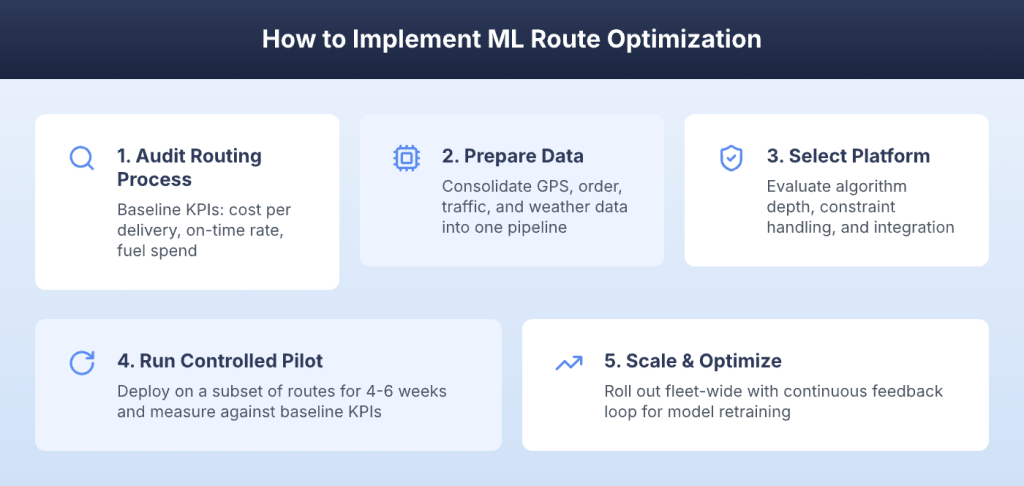
Adopting ML-powered routing does not require a data science team or custom infrastructure. The following five-step framework takes your fleet from concept to operational ML routing with clear milestones at each stage.
Step 1: Audit Your Current Routing Process
Assess your baseline before evaluating any platform. Document how routes are currently planned, what data you already collect, and where the biggest inefficiencies live. Establish benchmark KPIs, including cost per delivery, on-time rate, average route time, and fuel spend per route. These baselines become your measurement framework for ML impact.
Key Data Points to Collect
- Historical route completion times vs. planned times
- Fuel consumption per route
- Failed delivery rates and reasons
- Driver utilization percentages
- Customer time-window compliance rates
Step 2: Prepare Your Data Infrastructure
ML models are only as good as the data they learn from. Consolidate data from GPS trackers, order management systems, traffic APIs, and driver feedback into a unified pipeline. Clean historical data to remove anomalies like test routes or incomplete records. Ensure real-time data feeds for traffic, weather, and order updates are accessible to the routing engine.
Essential Data Sources for ML Routing
- GPS and telematics data (vehicle location, speed, idle time)
- Order management system (delivery windows, package dimensions, priority levels)
- Traffic and weather APIs (real-time and historical patterns)
- Customer data (access instructions, preferred time slots, delivery success history)
Step 3: Select the Right ML-Powered Routing Platform
Evaluate platforms based on algorithm sophistication, constraint handling, integration capabilities, and ease of use. Smart route optimization software like Upper Route Planner supports multi-driver route optimization, real-time recalculation, and continuous learning from completed routes. Look for solutions that handle real-world constraints like vehicle capacity, driver schedules, and time windows natively rather than requiring workarounds.
Platform Evaluation Criteria
- Number of stops and drivers supported
- Real-time route adjustment capabilities
- Integration with existing fleet management and order systems
- Constraint handling (time windows, vehicle types, driver skills)
- Analytics and reporting depth
- Mobile driver app functionality
Step 4: Run a Controlled Pilot Program
Deploy ML routing on a subset of routes or drivers before full rollout. Compare ML-optimized routes against your baseline KPIs over four to six weeks. Measure fuel savings, delivery time reductions, on-time rate improvements, and driver feedback. Use pilot data to fine-tune model parameters before scaling. Most fleets find that even a small pilot reveals 10-15% efficiency gains.
Pilot Program Success Metrics
- Fuel cost reduction percentage
- Average route completion time vs. baseline
- On-time delivery rate change
- Driver satisfaction scores
- Cost per delivery comparison
Step 5: Scale and Optimize Continuously
Roll out ML routing across all drivers and service areas. Establish a feedback loop where completed route data flows back into the model for retraining. Monitor KPIs weekly and adjust constraints as business needs evolve. As the model ingests more data, real-time route optimization predictions become progressively more accurate, compounding savings over each quarter.
Continuous Optimization Checklist
- Weekly KPI review dashboards
- Monthly model performance audits
- Quarterly constraint and parameter tuning
- Ongoing driver feedback collection
- Seasonal pattern adjustment protocols
Implementation brings measurable results, but it also surfaces challenges that need proactive planning. The next section covers the four most common obstacles and how to solve each one.
See it in action
Optimize 500+ Stops Across Multiple Drivers in Seconds
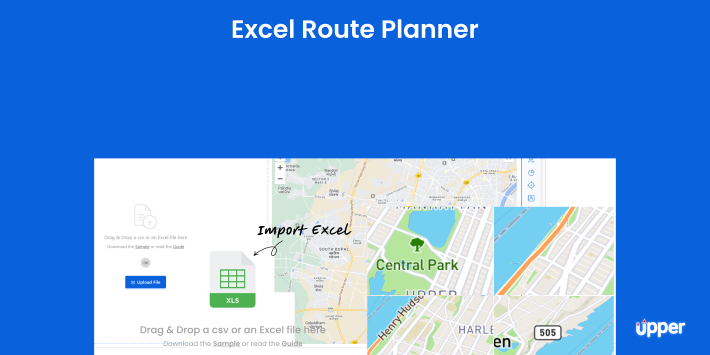
Upper handles the data infrastructure complexity for you. Import stops via spreadsheet, set constraints, and get optimized routes without building custom pipelines.
4 Challenges of Machine Learning Route Optimization (and How to Solve Them)
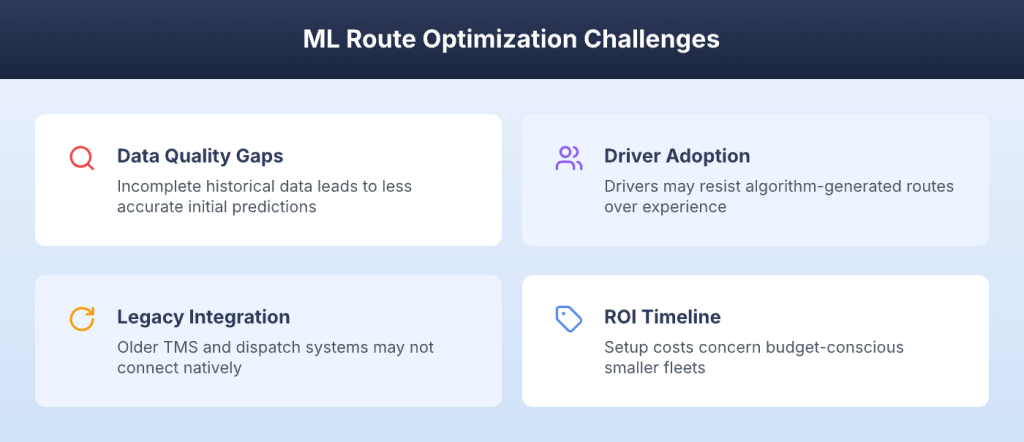
ML adoption in routing is not without friction. Understanding these challenges upfront helps you plan around them and avoid the setbacks that stall most implementations. Here are the four most common obstacles and the solutions that address each one.
Data Quality and Availability Gaps
Many fleets lack clean, consolidated historical data when they begin evaluating ML routing. GPS data lives in one system, order data in another, and driver feedback in spreadsheets or not at all. Incomplete data leads to less accurate initial predictions, which can erode confidence in the system.
Solution: Start with the data you have. Prioritize GPS and order data as your foundation, and let the ML model improve as data quality increases over time. Most platforms can generate meaningful optimizations even with partial historical data, refining predictions as the dataset grows.
Integration With Legacy Systems
Older TMS and dispatch systems may not connect natively with ML routing platforms. Custom integrations require development resources and can delay implementation by weeks or months.
Solution: Choose solutions with open APIs and pre-built integrations for common fleet management tools. Cloud-based platforms like Upper connect through API and spreadsheet import, eliminating the need for complex middleware. Automated route planning platforms built with integration in mind reduce setup time from months to days.
Driver Adoption and Trust
Drivers accustomed to familiar routes may resist algorithm-generated plans. Years of local knowledge make drivers skeptical that a system could plan better routes than their own experience. If drivers override optimized routes, the investment in ML routing is wasted.
Solution: Involve drivers early and demonstrate time savings during the pilot phase. Show them that ML routing accounts for the same variables they consider, like traffic, parking, and access issues, while also seeing patterns across the entire fleet. Maintain override capabilities for genuine local knowledge, and collect driver feedback to refine the model.
Cost of Implementation vs. ROI Timeline
Initial setup costs concern budget-conscious operations, especially smaller fleets. The fear of paying for a platform that takes months to deliver returns can stall the decision entirely.
Solution: Cloud-based SaaS platforms eliminate infrastructure investment. There is no hardware to install, no servers to maintain, and no data pipelines to build from scratch. Most fleets see positive ROI within two to three months through fuel and labor savings alone. Route optimization for small businesses is increasingly accessible because modern platforms scale pricing with fleet size.
Knowing these challenges and their solutions puts you in a stronger position to execute. The following best practices help you maximize results from day one.
6 Best Practices for Machine Learning Route Optimization
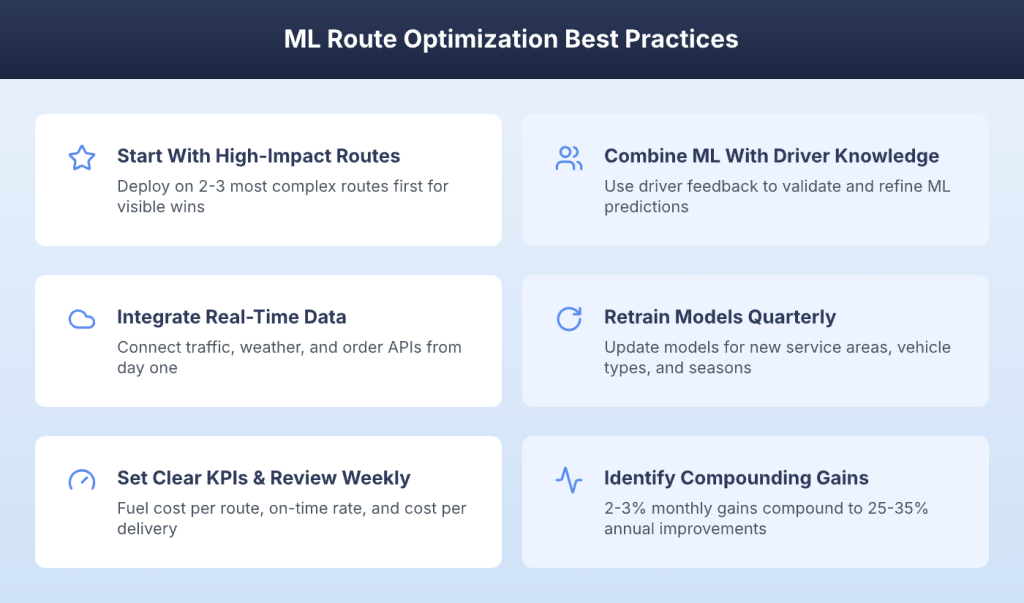
Execution determines whether ML routing delivers its full potential or falls short of expectations. Following these six best practices will help you maximize ROI and avoid the mistakes that slow most implementations.
Start With High-Impact Routes First
Trying to optimize every route on day one creates complexity and slows adoption. Identify your two to three most complex or costly routes and deploy ML routing there first. Visible wins on high-impact routes build internal confidence and make expanding to the full fleet an easy sell.
Integrate Real-Time Data Feeds From Day One
Connect traffic, weather, and order update APIs immediately rather than retrofitting later. ML models generate the most accurate predictions when they have access to live data from the start. Delaying integration means your initial results will underrepresent the platform’s full capability.
Set Clear KPIs and Review Weekly
Define success metrics before launch: fuel cost per route, on-time delivery rate, average route completion time, and cost per delivery. Review dashboards weekly to catch issues early and validate that the model is improving. Upper’s route management analytics dashboard provides this visibility in a single view.
Combine ML Insights With Local Driver Knowledge
Use driver feedback to validate and refine ML predictions rather than treating algorithms as infallible. Drivers notice access restrictions, parking challenges, and customer preferences that data alone may not capture. Build a formal feedback loop where driver observations are incorporated into model adjustments.
Retrain Models as Your Business Evolves
Update ML models when you add new service areas, vehicle types, or seasonal patterns. A model trained on summer data will underperform during winter conditions if not retrained. Schedule quarterly model reviews aligned with your business cycles.
Use Analytics to Identify Compounding Gains
Review route analysis data monthly to spot trends and compound incremental improvements. Small gains of 2-3% per month in fuel efficiency or stop density add up to 25-35% annual improvements. Look for patterns: which routes consistently underperform, which drivers exceed benchmarks, and where seasonal shifts create new optimization opportunities.
Best practices set the foundation. The next step is choosing a platform that puts these practices into action without requiring custom development.
See it in action
Track Route Efficiency Trends With Upper's Analytics Dashboard
Monitor fuel costs, on-time rates, and cost-per-stop data by driver, route, and time period. Spot patterns and compound gains quarter over quarter.
Optimize Your Routes With Upper’s Intelligent Routing Algorithms
Machine learning route optimization delivers measurable returns in fuel savings, delivery speed, on-time rates, and fleet scalability. The five-step implementation framework covered in this guide gives you a structured path from baseline audit to continuous optimization, and the best practices ensure you avoid the pitfalls that stall most deployments.
Upper’s advanced routing algorithms factor in traffic conditions, vehicle capacities, driver schedules, and time windows to generate optimized multi-stop routes in seconds. Whether you are managing a 10-driver courier fleet or a 50-vehicle distribution operation, Upper handles the constraints that make route planning complex and turns them into optimization opportunities.
The analytics dashboard provides the continuous improvement feedback loop this article describes, showing route efficiency trends, delivery performance, and cost-per-stop data so your team can spot patterns and compound gains over time. Upper handles the data infrastructure complexity as well.
Import stops via spreadsheet, integrate with existing systems through API, and track every driver in real time. Your team can start realizing ML routing benefits without building custom pipelines or hiring data engineers.
Book a demo to see how Upper’s routing algorithms can cut your fuel costs and delivery times within your first month of deployment.
FAQs on Machine Learning-Enabled Route Optimization
ML improves efficiency through pattern recognition, real-time adaptation, and predictive capabilities. The algorithms learn from thousands of completed routes to predict accurate travel times, anticipate delays before they happen, and recalculate routes dynamically when conditions change. This reduces mileage, fuel costs, and delivery times simultaneously.
Essential data sources include GPS and telematics data (vehicle location, speed, idle time), order management data (delivery windows, package details, priority levels), traffic and weather API feeds, and historical route performance records. Customer data like preferred time slots and delivery success history further improves model accuracy.
Most fleets see measurable fuel and time savings within two to three months of deployment. Initial efficiency gains of 10-15% typically appear during the pilot phase, with continuous improvement compounding those gains over subsequent quarters as the ML model ingests more operational data.
Yes. Cloud-based SaaS platforms make ML routing accessible to fleets of all sizes without requiring infrastructure investment. A five-driver fleet benefits from the same optimization algorithms as a 50-driver operation. The key is choosing a platform that scales pricing with fleet size so smaller operations are not paying for enterprise-level capacity.
AI is the broader field encompassing any system that mimics intelligent decision-making, including rule-based systems. Machine learning is a subset of AI focused specifically on algorithms that learn from data and improve over time without being explicitly programmed. In route optimization, ML refers to the predictive and adaptive capabilities that make routing smarter with each delivery.