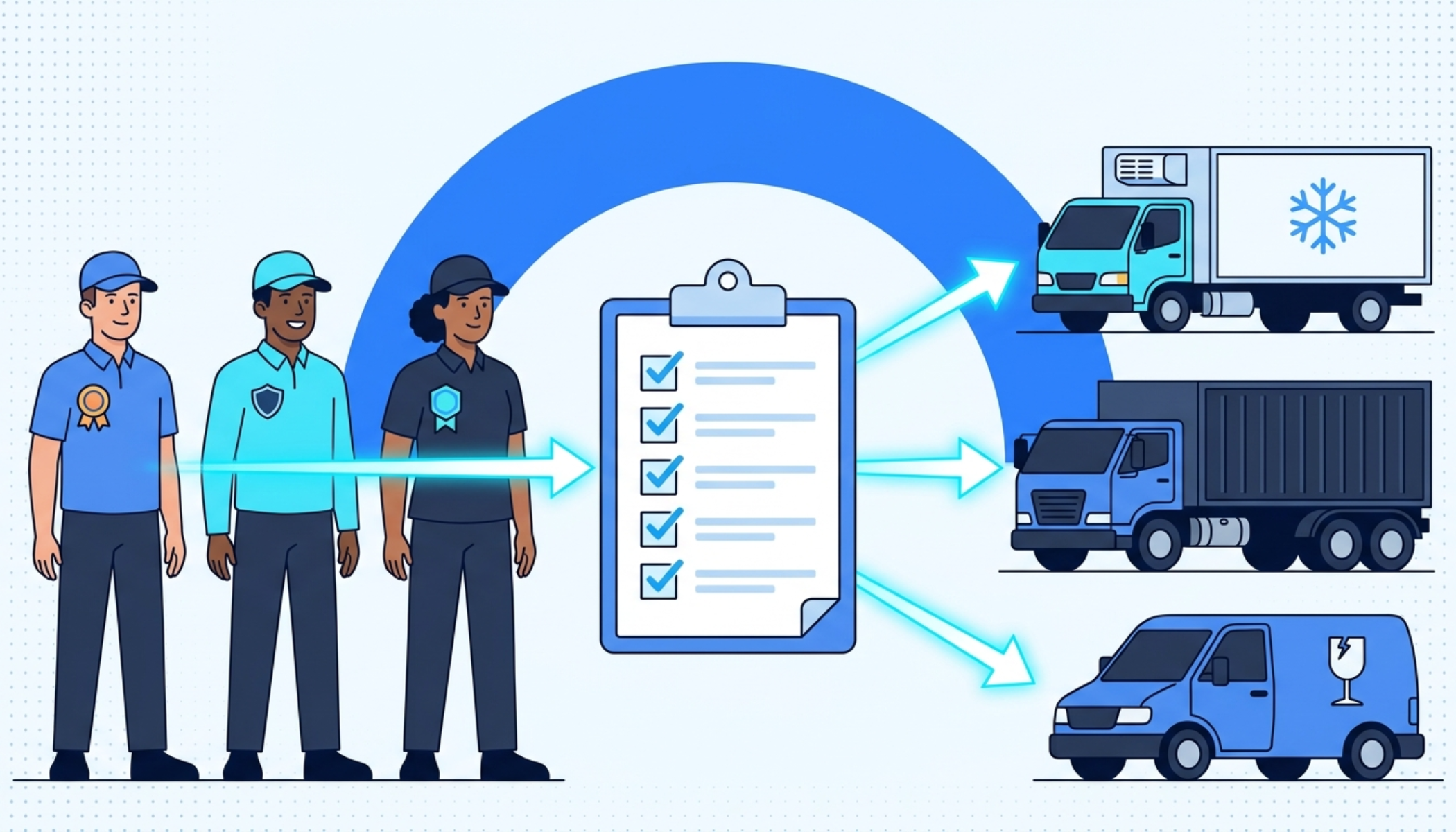
- Logistics skill-based routing filters eligible driver-job or resource-job pairs before assignment and route sequencing.
- Credentials, legal endorsements, required equipment, and minimum proficiency are usually hard rules; familiarity and account continuity are usually preferences unless policy says otherwise.
- Skill records need a controlled name, level definition, start date, end date, evidence owner, and review process. A tag alone does not prove current qualification.
- The correct output can leave a job unassigned. Silent substitution is worse than a visible exception when no qualified resource exists.
- A valid pilot measures eligibility, unassigned work, overrides, expiry coverage, route feasibility, service performance, and planning effort against the same baseline days.
The wrong driver-job match can make an otherwise efficient route impossible to execute. A required endorsement is missing, a certification expired, the assigned vehicle lacks the needed equipment, or the worker is outside the approved territory. Route sequence cannot repair an ineligible assignment.
In contact centers, skill-based routing sends a conversation to a suitable agent. In logistics and field service, the same phrase describes a different operating problem: first determine who and what may perform each job, then assign and sequence the work. Microsoft’s Field Service documentation illustrates this broader requirement model with duration, time window, location, territory, characteristics, resource type, and priority fields.
This guide gives you a practical data model and decision order: Eligibility, Assignment, then Sequencing. You will learn how to distinguish hard qualifications from preferences, represent effective dates and proficiency, leave a job unassigned when no valid match exists, and test how eligibility interacts with capacity, time windows, geography, and workload.
It also sets a product boundary. Driver profiles and route constraints can support the workflow, but a routing platform should not be treated as your legal or training system of record unless you have verified that exact function.
I work on driver and dispatch workflows at Upper, and the most expensive scheduling errors I see are the ones where the driver was free but not qualified.
What is Skill-Based Routing in Logistics?
Skill-based routing in logistics matches each job to an eligible driver, technician, vehicle, equipment item, or crew before the assigned work is sequenced into feasible routes.
The word skill is convenient but incomplete. Eligibility may depend on a learned skill, certification, license, vehicle class, attached equipment, territory authorization, shift availability, customer approval, or a valid combination of resources.
A useful workflow therefore has three stages. The first removes invalid assignment pairs. The second chooses among eligible resources. The third builds executable routes around those assignments.
| Stage | Decision | Output | Failure that must stay visible |
| Eligibility | Can this resource perform this job at this time? | Allowed driver-job or resource-job pairs | Missing, expired, or conflicting requirement |
| Assignment | Which eligible resource should own the work? | One assignment or a valid resource group | No eligible resource or unresolved tie |
| Sequencing | In what order should assigned work run? | Feasible route and schedule | Capacity, window, break, or route conflict |
What Does an Eligibility Rule Look Like?
For driver d, job j, and scheduled time t, eligibility is true only when every hard requirement for j is present and valid for d at t, and every linked vehicle, equipment, territory, availability, and policy rule also passes. The model should not assign a job first and check qualifications later.
Soft preferences are scored only after hard eligibility passes. That order prevents a nearby but unqualified driver from winning merely because the route is shorter.
This distinction matters because the same phrase is often used for contact-center routing, where the operating constraints are different.
How Is Logistics Skill-Based Routing Different From Contact-Center Routing?
Contact-center routing chooses an agent for an interaction, while logistics routing must also account for physical resources, travel, time, safety, capacity, and job execution.
Both settings compare demand requirements with resource attributes. The shared pattern ends there. A transferred chat can enter another queue; a worker already on the road may need a different vehicle, tool, travel plan, or appointment window before the job becomes feasible.
| Dimension | Contact center | Logistics or field service |
| Work item | Call, chat, email, or case | Delivery, pickup, inspection, installation, or service job |
| Resource | Agent | Driver, technician, vehicle, equipment, facility, or crew |
| Location | Often irrelevant to transfer | Affects travel time, territory, access, and sequence |
| Capacity | Concurrent interaction or queue capacity | Vehicle load, work hours, crew capacity, or tool availability |
| Failure path | Queue, transfer, or callback | Visible unassignment, reschedule, substitute resource, or exception approval |
| Optimization | Response, transfer, and queue objectives | Eligibility, assignment, travel, time, workload, and service objectives |
For search clarity, this guide uses skill-based routing to mean the logistics and field-service model from this point forward.
Which Data and Rules Does Skill-Based Routing Need?
The model needs versioned job requirements, versioned resource capabilities, linked vehicle and equipment data, availability, geography, service constraints, and an explicit matching policy.
Microsoft separates scheduling fields such as duration, dates, promised windows, location, territory, resource type, priority, and required characteristics. Its resource-characteristics guide shows that characteristics can represent skills or certifications, and that rating models can define proficiency levels. That structure is more useful than one free-text skills column.
| Record | Required fields | Control question |
| Job requirement | Canonical requirement, hard/soft status, minimum level, effective time, acceptable alternatives | What must be true to release this work? |
| Person or crew | Capability, level, start/end dates, evidence owner, territory, availability | Who is qualified at the scheduled time? |
| Vehicle | Type, capacity, restrictions, availability, assigned driver | Can the vehicle legally and physically support the work? |
| Equipment | Type, quantity, location, service status, linked resource | Is the required tool or asset available with the assignee? |
| Route rule | Start/end, window, duration, break, precedence, priority | Can eligible work form an executable route? |
| Audit event | Assignment, override, reason, user, timestamp, before/after value | Can you explain why the match changed? |
How Should You Build a Controlled Skill Taxonomy?
Give each requirement one canonical name, owner, definition, allowed levels, evidence type, review frequency, and retirement rule. Keep aliases in the data dictionary, not as duplicate tags. If two terms mean different things, document the boundary instead of merging them for convenience.
Use AND logic when every requirement must be present. Use OR logic only for approved alternatives, such as either of two equivalent product certifications. Put the logic on the job template so dispatchers do not rebuild it from memory each morning.
Why Do Effective Dates Matter?
Salesforce Field Service documents start and end dates on resource-skill records and a numeric skill level from 0 to 99.99. The range is vendor-specific, not a universal standard. The durable lesson is that a qualification can be time-bound and that its level needs a defined scale.
Store the scheduled service time, not only the plan creation time, in the validity check. A credential that is valid today but expires before next week’s appointment should not pass next week’s eligibility test.
Which Requirements Should Be Hard Rules and Which Should Be Preferences?
Make legal, safety, contractual, physical, and minimum-competence requirements hard; use preferences only where an authorized substitute remains feasible.
A hard rule removes a resource from the candidate set. A soft rule changes the score among eligible candidates. Mixing the two creates a dangerous failure mode: the optimizer may trade a qualification away to save travel time.
| Requirement | Typical treatment | Why | Allowed fallback |
| Current legal endorsement | Hard | Operation may be prohibited without it | Hold or assign another qualified resource |
| Required customer authorization | Hard | Contract or site rule controls access | Escalate to an approved substitute |
| Minimum verified proficiency | Hard | Job defines a competence floor | Use a qualified worker or reschedule |
| Required vehicle or equipment | Hard | Work cannot be executed without the resource | Swap the linked asset or assignment |
| Preferred technician | Soft unless contract makes it hard | Continuity may help but substitution can be valid | Score another eligible resource |
| Local familiarity | Soft | Useful after eligibility, not a qualification | Use route data and job notes |
| Workload balance | Objective or soft rule | Improves distribution among eligible resources | Trade against travel or priority within policy |
How Should Regulated Credentials Be Handled?
Treat a dispatch tag as a pointer to verified evidence, not the evidence itself. For example, FMCSA’s CDL guidance says certain commercial motor vehicles have required a CDL since April 1, 1992, and lists six endorsement codes: T, P, N, H, X, and S. Applicability still depends on the vehicle, cargo, jurisdiction, and current rule.
Assign compliance ownership to qualified staff, store the governing evidence where policy requires it, and make the routing record consume only the approved validity status. Routing software should not make a legal determination by itself.

See it in action
Sequence jobs after the candidate set is valid
Use route planning to compare time, distance, windows, priorities, and territories after your qualification policy has removed invalid driver-job pairs.

Once the hard-versus-soft policy is approved, implementation becomes a controlled data and exception workflow.
How Does Skill-Based Routing Work Step by Step?
Implement skill-based routing by defining requirements, governing profiles, generating eligible pairs, assigning only eligible resources, sequencing feasible routes, controlling overrides, and measuring the pilot.
Do not begin with a long list of skill tags. Begin with the jobs that create the highest consequence when assigned incorrectly, then build the minimum reliable model for those jobs.
| Step | Action | Required output | Release gate |
| 1 | Choose one job family and write its requirements | Approved requirement template | Owner confirms hard and soft rules |
| 2 | Create resource, vehicle, and equipment profiles | Versioned capability records | Evidence and effective dates are complete |
| 3 | Map canonical names, levels, and alternatives | Controlled taxonomy and logic | No duplicate or ambiguous requirement |
| 4 | Generate the eligibility matrix | Allowed and rejected assignment pairs with reasons | Every rejection is explainable |
| 5 | Assign and sequence only eligible pairs | Feasible routes plus visible unassigned work | Every hard rule passes |
| 6 | Review exceptions and overrides | Approved change with reason and owner | No silent bypass |
| 7 | Replay normal and stress days | Comparable scorecard | Predefined acceptance gates pass |
What Should an Eligibility Matrix Show?
Rows are jobs, columns are candidate resources, and each cell records eligible, ineligible, or review required. Keep a reason code beside every rejected or conditional pair, such as expired certification, insufficient level, wrong vehicle, missing equipment, outside territory, off shift, or conflicting booking.
A sparse matrix is not automatically a data problem. It may reveal a real coverage risk. The operating question is whether the team can add coverage, change the job window, attach a different resource, or leave the job unassigned without bypassing policy.
How Can You Test the Model Without Invented ROI?
Use one normal day and one stress day. Freeze the jobs, resources, effective dates, travel inputs, and acceptance rules. Compare the current plan and the skill-aware plan on the same work. Record every manual correction and every job that remains impossible.
Do not convert a modeled difference into a savings forecast unless you have measured the full operational effect and documented the denominator, period, and exclusions.
See it in action
Schedule qualified resources without hiding gaps
Use the scheduling guide to coordinate availability, time windows, route release, and contingency coverage after your eligibility rules are defined.
The next test is whether other route constraints preserve the eligibility decision or quietly override it.
How Should Skills, Capacity, Time Windows, and Geography Interact?
Skills determine who may perform the job; capacity, time, location, and workload determine which eligible assignment creates a feasible operating plan.
Treat each category as its own constraint family. A driver may be qualified but unavailable. A vehicle may be compatible but full. A job may have an eligible worker but no reachable time slot. The route model must expose the failing family.
| Constraint family | Question | If it fails | Do not do |
| Skill or credential | Is every mandatory capability valid at service time? | Reject the assignment pair | Lower the level to force coverage |
| Vehicle or equipment | Are required linked assets compatible and available? | Swap asset, resource, or time | Treat a driver tag as proof of equipment |
| Capacity | Does load stay within every modeled limit? | Reassign, split if allowed, or leave unassigned | Overload an otherwise qualified route |
| Time window and duration | Can travel and service fit inside availability? | Move, reschedule, or expose conflict | Delete service time to make the plan fit |
| Geography and territory | May the resource serve the site and reach it? | Use another territory or escalate | Use proximity as a substitute for authorization |
| Workload and priority | Which feasible plan best meets policy objectives? | Score among eligible plans | Trade away a hard rule |
Oracle’s work-skills documentation makes the distinction concrete: a resource can have several skills, an activity can require several skills, and the resource must meet every required level. Oracle’s documented scales are 1-100 for resource levels, 0-100 for required levels, and 1-100 for preferred levels. Those numbers describe Oracle’s model, not a universal scale you should copy.
See it in action
Test capacity beside qualification rules
Define matching stop demand and vehicle limits, then verify that qualified assignments remain load-feasible after every pickup and delivery.
Even a complete model needs an explicit policy for exceptions, missing data, and jobs that need more than one resource.
How Do You Handle No-Match, Expired, and Multi-Resource Cases?
Keep exceptions visible, separate missing data from genuine infeasibility, and require an approved resolution path for every override or resource group.
The correct automated answer is sometimes no assignment. That answer protects dispatch from releasing work that the modeled resources cannot execute.
| Case | System response | Dispatcher decision | Audit record |
| No eligible person | Leave job unassigned with reason | Add qualified coverage, move time, or escalate | Candidate set and failure reasons |
| Expired or future-dated skill | Reject at scheduled service time | Renew through the proper process or reassign | Validity dates and evidence owner |
| Missing requirement data | Hold for data review | Repair template or confirm no requirement applies | Before/after requirement |
| Approved substitute | Offer only policy-approved alternative | Accept or reject with reason | Substitution rule and approver |
| Technician plus equipment | Create a resource group | Book compatible resources together | Group membership and shared time |
| Two-person crew | Require all roles or a prequalified crew | Choose a complete group | Role-to-resource match |
| Manual override | Warn and require authorization | Resolve the hard-rule conflict before release | User, timestamp, reason, and final state |
Which Vendor Defaults Must Be Tested?
Never assume an empty skill profile or empty job requirement has the same meaning across systems. Oracle documents that a resource with no specific skills can be treated as having every skill at level 100. Salesforce documents that an appointment with no specified required skills can treat every resource as a valid candidate.
Salesforce’s Match Skills rule can exclude candidates below a required level and validates the time-phased skill state. Use vendor documentation and a deliberately incomplete test record to verify how your configuration handles blanks, expired values, and missing requirements.
A safe default for high-consequence work is fail closed: missing required data creates a review queue, not an unrestricted assignment.
Which Metrics Show Whether Skill-Based Routing Is Working?
Measure qualification feasibility and exception quality first, then compare route, service, workload, and planning metrics on the same jobs and resource pool.
A shorter route with more qualification exceptions is not an improvement. Keep the skill and compliance measures in the same scorecard as distance, time, lateness, and planning effort.
| Measure | Definition | Why it matters | Acceptance gate |
| Eligible assignment rate | Released jobs whose assignee passed every hard rule | Tests the core promise | 100% for modeled hard requirements |
| Skill-caused unassigned jobs | Jobs left open because no valid candidate exists | Exposes coverage risk | Visible, reason-coded, and owned |
| Missing-data holds | Jobs or resources stopped for incomplete requirement data | Separates data debt from true scarcity | No silent unrestricted default |
| Override rate and reason | Manual assignment changes by category | Finds weak rules and unsafe bypasses | Every override authorized and traceable |
| Expiry coverage | Time-bound records with owner and review before end date | Prevents stale eligibility | No expired record passes |
| Route feasibility | Capacity, windows, breaks, start/end, and precedence pass | Protects execution after matching | Every released route passes |
| Service outcome | Completion, first-attempt result, lateness, and return work by job type | Checks field effect | No critical regression |
| Planning effort | Import through approved release, including corrections | Captures total dispatcher work | Meets the operating deadline |
How Should You Compare Baseline and Pilot Days?
Use the same job set, resource pool, travel assumptions, and service rules. Report both the numerator and denominator for every rate. Preserve jobs that the baseline forced onto an unqualified resource so the pilot does not look worse merely because it surfaces an existing risk.
Review results by job family and requirement type. A total average can hide one high-consequence category with poor coverage.
How Do You Evaluate Skill-Based Routing Software?
Evaluate the data model, rule semantics, exception behavior, explainability, audit controls, routing integration, and measured pilot result rather than accepting a skills checkbox.
Ask the vendor to configure one difficult representative day. Include an expired record, a missing requirement, a lower-than-required proficiency, a multi-resource job, a capacity conflict, and a time-window conflict. The demonstration should show what is rejected and why.
| Evaluation area | Question to test | Evidence to retain | Red flag |
| Data model | Can jobs and resources carry canonical, time-bound requirements? | Field definitions and sample records | Free-text tags with no owner or validity |
| Logic | Can rules express AND, approved OR, levels, hard rules, and preferences? | Configuration and edge-case results | Every rule becomes a weighted preference |
| Eligibility | Can you see candidate and rejection reasons? | Eligibility matrix or explainable result | Black-box assignment |
| Exceptions | What happens when no resource qualifies or data is blank? | Unassigned queue and reason codes | Silent fallback to any driver |
| Resource groups | Can a person, vehicle, equipment item, and crew be linked? | Multi-resource test | Only one flat driver tag list |
| Routing | Do capacity, windows, territories, service time, and breaks remain hard? | Feasibility report | A shorter route overrides eligibility |
| Governance | Are changes, overrides, users, times, and reasons recorded? | Audit export | No durable change history |
| Pilot | Does the same baseline pass every acceptance gate? | Normal-day and stress-day scorecards | Demo examples replace your data |
What Should You Verify in Upper?
Verify the surrounding workflow with your own configuration: route planning, vehicle capacity, territories, priorities, time windows, driver availability, manual review, and route release. Then ask whether your required skill or credential fields can operate as hard assignment constraints for your account and how rejected work appears.
Do not treat a route-planning demo as proof that a routing platform stores compliance evidence, renews credentials, validates law, or replaces your training and safety systems. Put each responsibility in writing before the pilot.
With that boundary in place, the buying question becomes what Upper should support and what your team must still govern.
Conclusion: Where Does Upper Fit in Skill-Based Routing?
Upper fits around the route-planning and capacity decisions that follow a governed eligibility policy, but your team must verify the exact assignment fields and remain the authority for qualifications.
A reliable skill-based routing process does not begin with route order. It begins with approved job requirements, current resource records, explicit hard and soft rules, and a visible no-match path. Assignment and sequencing follow only after invalid pairs are removed.
Upper can be evaluated for production-verified route planning and capacity optimization using the same representative route days and acceptance gates in this guide. This article does not claim that Upper is a certification system of record, determines legal eligibility, or natively enforces every skill taxonomy and proficiency rule described above.
Bring one normal day, one stress day, your requirement dictionary, and the exception cases the workflow must reject. Book an Upper demo to test the route-planning and capacity workflow against your actual rules before you release it to daily operations.
The most common questions concern terminology, qualifications, preferences, missing matches, skill levels, equipment, and the boundary between matching and route optimization.
Use these answers as policy checks. Your operating, legal, and contractual requirements should control the final rule set.
What Are the Frequently Asked Questions About Skill-Based Routing?
No. Skill-based routing determines which resources are eligible and which eligible resource should own the job. Route optimization sequences and balances assigned work under travel and operating constraints. A system may combine both stages, but the decisions remain distinct.
No. Proximity is useful only after every hard requirement passes. A nearby resource with an expired credential, wrong vehicle, missing equipment, or insufficient proficiency is not an eligible candidate.
Yes, when an approved customer, safety, security, or contract rule makes substitution invalid. Otherwise, treat preference as a scoring factor among eligible resources so one person’s absence does not make routine work impossible.
Leave the job unassigned with a reason. Add qualified coverage, change the appointment within policy, attach a compatible resource group, use an approved substitute, or escalate. Do not silently drop a requirement.
No. Use a level only when the business can define, verify, and maintain it consistently. A binary current-or-not-current credential may be clearer than an arbitrary number. Vendor ranges are implementation details, not universal standards.
Model them as linked resource requirements. The driver may be qualified while the assigned vehicle or equipment is not. Eligibility should pass only when the full resource combination can perform the work.
Not by assumption. Routing can consume an approved eligibility status, but legal interpretation, evidence retention, renewal, training, and compliance ownership require their own qualified process unless the exact product responsibility is verified.