

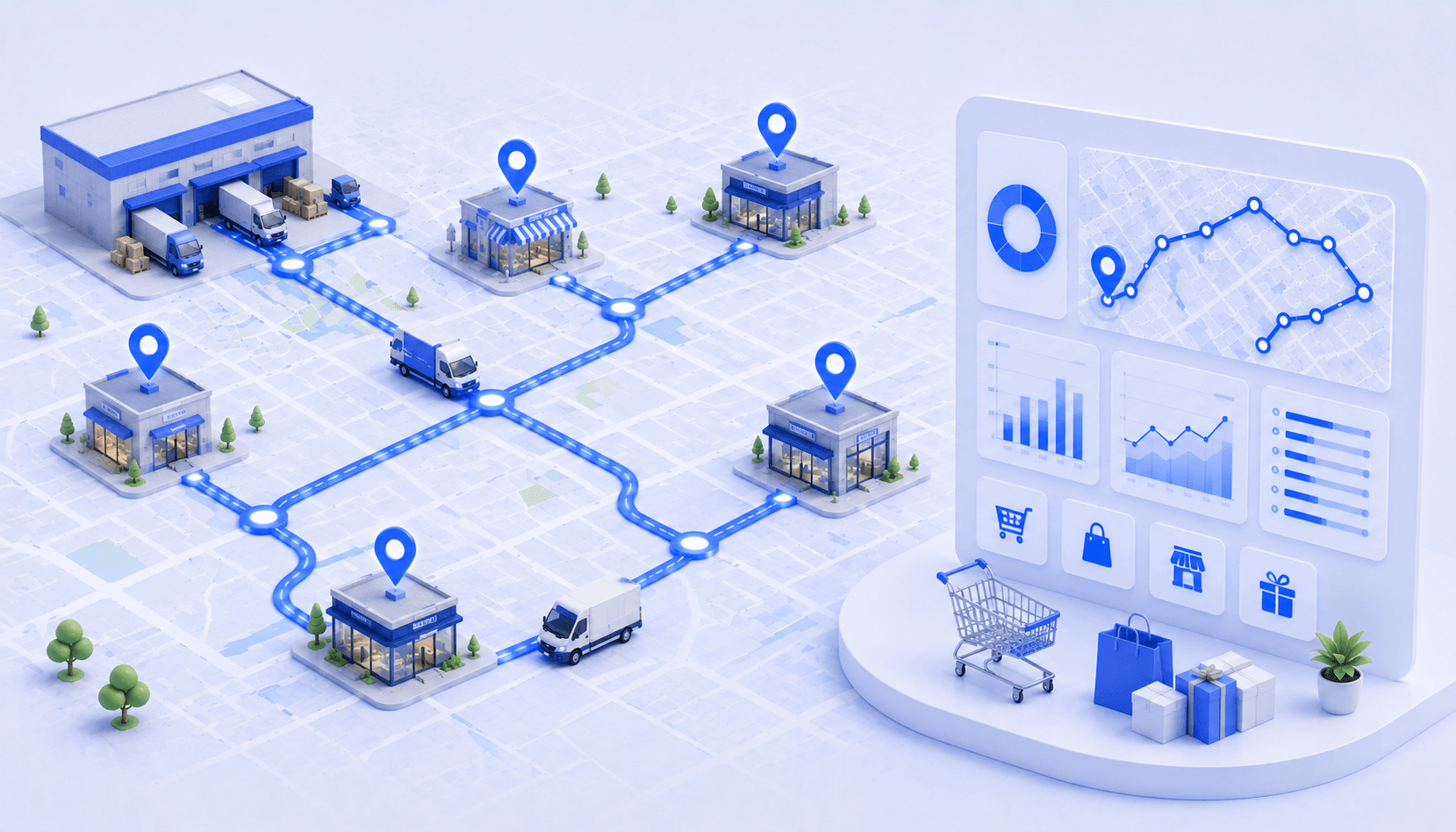
Supply chain bottlenecks can slow down entire operations, increase costs, and disrupt customer deliveries. A single delay at any stage, whether in sourcing, warehousing, transportation, inventory management, or last-mile delivery, can create ripple effects across the entire supply chain.
As supply chains become more complex and customer expectations for faster deliveries continue to rise, businesses are under increasing pressure to identify and eliminate operational inefficiencies quickly.
These disruptions do more than delay shipments. They increase fuel costs, reduce delivery capacity, create stockouts, impact customer satisfaction, and make it harder for businesses to scale efficiently.
In this guide, we’ll break down the most common supply chain bottlenecks, explain what causes them, and explore strategies businesses can use to improve visibility, streamline logistics operations, and build more resilient supply chains.
Table of Contents
- 1. Single-Source Supplier Dependencies
- 2. Demand Forecasting Errors
- 3. Warehouse Receiving and Processing Delays
- 4. Inefficient Route Planning and Delivery Sequencing
- 5. Driver Shortages and Allocation Imbalances
- 6. Vehicle Capacity Mismatches
- 7. Lack of Real-Time Supply Chain Visibility
- 8. Manual Dispatching and Communication Processes
- 9. Failed First-Attempt Deliveries
- 10. Information Silos Between Supply Chain Partners
- Eliminate Last-Mile Bottlenecks With Upper Route Planner
1. Single-Source Supplier Dependencies
Relying on a single supplier for critical materials is one of the most common supply chain bottleneck examples. When that one source fails, the entire downstream chain stops moving.
What It Is
A single-source dependency exists when one supplier provides a material, component, or service with no qualified alternative in place. This bottleneck surfaces when that supplier hits capacity limits, experiences quality failures, or faces geopolitical disruptions or natural disasters.
How to Overcome This Bottleneck
Start by conducting a supplier concentration audit. Identify any category where more than 40% of the spend goes to a single source. For every critical input, qualify at least one secondary supplier and negotiate flexible volume agreements that allow rapid scaling when your primary source faces constraints. For immediate relief, maintain two to four weeks of safety stock for single-sourced materials as a buffer while you bring backup suppliers through the qualification process.
Best Practices for Prevention
- Develop a supplier scorecard that tracks on-time delivery, defect rates, and lead time consistency across all key vendors
- Run quarterly business reviews with strategic suppliers to surface capacity risks and production constraints before they become disruptions
- Build geographic diversity into your supplier base so that a regional event does not take out your entire supply for a critical input
2. Demand Forecasting Errors
Inaccurate demand forecasts create a cascade of supply chain disruptions. Overstocking ties up capital and warehouse space, while understocking triggers stockouts, emergency shipments, and missed delivery commitments.
What It Is
Demand forecasting errors occur when predicted order volumes diverge significantly from actual customer demand. Overforecasting leads to excess inventory, increased carrying costs, and warehouse congestion that slows picking and shipping.
Underforecasting triggers the opposite problem: stockouts, rush replenishment orders, and delivery commitments your logistics operation cannot fulfill on time.
How to Overcome This Bottleneck
Blend historical sales data with leading indicators like marketing campaigns, seasonal patterns, and economic signals to build more accurate projections. Implement ABC classification to focus your highest forecasting precision on high-value, high-volume items where errors hurt most.
Review and adjust forecasts monthly using the most recent 90 days of data, and target forecast accuracy of 80-90% at the SKU level.
Best Practices for Prevention
- Share rolling demand forecasts with suppliers so they can align upstream production capacity with your expected order volumes
- Use demand sensing tools that incorporate real-time point-of-sale data to catch shifts in buying patterns before they become full forecast misses
- Build safety stock buffers calibrated to demand variability for each SKU rather than applying fixed thresholds across your entire inventory
3. Warehouse Receiving and Processing Delays
When the warehouse cannot receive, process, or pick orders fast enough, inventory sits idle on docks while outbound shipments back up. These logistical issues compound quickly during peak seasons.
What It Is
Warehouse bottlenecks form when inbound receiving, picking, packing, or staging operations cannot keep pace with order volume. Common symptoms include receiving dock congestion, long dock-to-stock cycle times, pick accuracy below 99%, and growing order backlogs. These delays are often invisible until a demand spike or seasonal surge exposes the capacity limit.
How to Overcome This Bottleneck
Implement zone-based picking strategies to reduce travel time within the warehouse. Deploy barcode scanning at receiving, picking, and shipping stages to eliminate manual entry errors that cause rework.
Redesign your floor layout based on order frequency data so that fast-moving SKUs sit nearest to shipping docks. Add receiving dock appointment scheduling to prevent congestion during peak hours.
Best Practices for Prevention
- Track dock-to-stock cycle time and pick accuracy as daily KPIs and escalate when either metric trends downward
- Conduct quarterly layout optimization reviews based on changing product mix and seasonal demand shifts
- Cross-train warehouse staff to shift between receiving, picking, and loading during demand spikes so no single function becomes a chokepoint

See it in action
Resolve Transportation Bottlenecks With Route Optimization
Inefficient routes are the most controllable transportation bottleneck. Upper's algorithms calculate optimal sequences for your entire fleet in under a minute.
4. Inefficient Route Planning and Delivery Sequencing
Unoptimized delivery routes are the most controllable supply chain bottleneck, and one of the most expensive. When drivers backtrack, miss time windows, and complete fewer stops per day, the cost compounds across the entire fleet.
What It Is
Route planning bottlenecks occur when delivery sequencing is manual, suboptimal, or fails to account for traffic, time windows, and vehicle capacity. Unoptimized routes waste an average of two to three hours per driver daily in unnecessary drive time.
This bottleneck compounds across the fleet: 10 drivers losing two hours each equals 20 hours of lost delivery capacity every day. Supply chain route optimization addresses this by replacing guesswork with data-driven sequencing.
How to Overcome This Bottleneck
Replace manual route planning with algorithmic optimization that sequences stops by proximity, traffic patterns, and delivery windows. Factor in vehicle capacity constraints to prevent overloading and reduce the number of required trips.
Enable real-time route adjustments for last-minute order changes, cancellations, or traffic disruptions. Measure impact by benchmarking cost per delivery and miles per stop before and after optimization. Route optimization software handles these calculations for entire fleets in seconds.
Best Practices for Prevention
- Optimize routes daily, not weekly. Conditions change, and static routes degrade quickly
- Track route adherence in real time to catch deviations before they cascade into missed deliveries
- Use analytics to identify recurring problem zones where deliveries are consistently late, or failure rates are high
- For fleets running 20+ vehicles, route optimization typically reduces fuel costs by 20-40% and increases stops per vehicle by 15-25%
5. Driver Shortages and Allocation Imbalances
Having too few drivers or misallocating available drivers across routes creates delivery backlogs that ripple through the supply chain. This logistics bottleneck is both a capacity problem and an assignment problem.
What It Is
Driver allocation bottlenecks occur when demand for deliveries exceeds available driver capacity, or when drivers are unevenly distributed across routes and zones. This bottleneck manifests as growing delivery backlogs, overtime costs, and missed time windows. The problem worsens during peak seasons and in regions with chronic driver shortages.
How to Overcome This Bottleneck
Use dispatch management to assign routes based on driver location, availability, and vehicle capacity rather than manual allocation. Balance workloads across the fleet so no single driver is overloaded while others run light routes.
Implement shift scheduling that aligns driver availability with peak delivery demand periods. For immediate relief, reassign stops from overloaded routes to underutilized drivers mid-day based on real-time progress data.
Best Practices for Prevention
- Track driver utilization rate as a weekly KPI to catch imbalances before they become backlogs
- Build flexible scheduling that allows rapid scaling with part-time or contract drivers during peak periods
- Automate dispatch assignment to eliminate the manual bottleneck of a dispatcher coordinating routes by phone or text
6. Vehicle Capacity Mismatches
Sending vehicles out underloaded wastes trips. Overloading causes failed deliveries and safety violations. Capacity mismatches are a hidden cost multiplier that most operations overlook.
What It Is
Capacity bottlenecks occur when vehicle loads do not match vehicle capabilities. Underloaded vehicles increase cost per delivery and total fleet mileage. Overloaded vehicles trigger failed deliveries, return trips, and compliance violations. Both scenarios waste resources.
How to Overcome This Bottleneck
Factor in package dimensions, weight limits, and vehicle-specific constraints during the route planning process. Use capacity-aware distribution to assign stops across the fleet based on actual load requirements, not just stop count. Match vehicle types to delivery requirements: heavy or bulky deliveries go on appropriate vehicles, not the next available one.
Best Practices for Prevention
- Track vehicle utilization rate (actual load versus maximum capacity) as a fleet-level KPI
- Consolidate shipments headed to the same zone or delivery window to maximize each trip
- Review vehicle-to-route matching monthly and adjust as product mix or delivery patterns change
See it in action
Optimize Routes Based on Vehicle Capacity
Upper helps prevent overloaded vehicles, underutilized fleet capacity, and inefficient delivery runs with automated routing based on load constraints and vehicle capacity.
7. Lack of Real-Time Supply Chain Visibility
When teams cannot see where goods are in the pipeline, small delays grow into major supply chain disruptions before anyone responds. Visibility gaps are the silent accelerator behind most bottleneck cascades.
What It Is
Visibility bottlenecks exist when supply chain teams operate on delayed or incomplete data, typically 24-48 hours behind real time. Without live tracking, delivery delays are discovered only when customers call or when end-of-day reports surface failures.
How to Overcome This Bottleneck
Implement GPS-based fleet tracking for real-time visibility into every vehicle’s location, route progress, and estimated arrival time. Connect procurement, inventory, warehouse, and transportation data into a unified dashboard. Set automated alerts for KPI deviations: late departures, missed time windows, and inventory thresholds breached.
Best Practices for Prevention
- Establish a daily operations review using live dashboard data instead of manual status updates
- Integrate customer notification systems so recipients receive automated ETAs without calling dispatch
- Prioritize visibility at the last-mile stage first, as this is where bottlenecks most directly impact customers, and tracking important supply chain KPIs becomes critical
8. Manual Dispatching and Communication Processes
Phone-based dispatching and manual status updates create a human capacity limit that becomes a transportation bottleneck as delivery volume scales. This is one of the first supply chain constraints to break when operations grow.
What It Is
Manual dispatch bottlenecks occur when route assignment, driver communication, and status tracking depend on phone calls, text messages, or spreadsheets. A single dispatcher can manage only eight to 12 drivers effectively using manual methods.
Beyond that threshold, coordination breaks down. Every manual handoff introduces delay and error potential, and scaling logistics operations becomes impossible without automation.
How to Overcome This Bottleneck
Automate route assignment by pushing optimized routes directly to driver mobile apps, eliminating morning coordination chaos. Replace phone-based status updates with GPS tracking that shows real-time driver progress on a centralized dashboard.
Use automated customer notifications to eliminate “where is my delivery” calls that consume dispatcher time and pull them away from exception management.
Best Practices for Prevention
- Measure dispatcher capacity: if dispatchers spend more than 60% of their time on routine coordination rather than exception management, automation is overdue
- Implement a dispatch platform that handles assignment, tracking, and communication in a single system
- Free dispatchers to focus on exception handling and real-time problem solving, the high-value work that keeps operations on track
9. Failed First-Attempt Deliveries
Every failed delivery requires a re-attempt, doubling the cost and consuming driver capacity that should serve new orders. Failed deliveries are among the most measurable and preventable supply chain bottleneck examples.
What It Is
Failed first-attempt deliveries occur when the recipient is unavailable, the address is incorrect, or the delivery falls outside the agreed time window. Re-delivery attempts consume driver hours, vehicle capacity, and route slots that could serve new orders, creating a compounding bottleneck that gets worse with volume.
How to Overcome This Bottleneck
Send automated delivery notifications with accurate ETAs so recipients can prepare for arrival. Validate addresses during order intake to catch errors before they become failed deliveries on the road.
Use time window constraints in route planning to ensure deliveries arrive when recipients expect them. Capture proof of delivery through photos and signatures to resolve disputes without costly re-delivery.
Best Practices for Prevention
- Track first-attempt delivery success rate as a weekly KPI with a target of 95% or higher
- Analyze failed delivery patterns: if certain zones, time slots, or customer types have higher failure rates, adjust routing and communication accordingly
- Offer a delivery time window selection to customers at checkout to increase the likelihood of someone being available
See it in action
Reduce Failed Deliveries With Automated Customer Notifications
Upper sends automated SMS and email notifications with accurate ETAs so recipients are ready when your driver arrives.
10. Information Silos Between Supply Chain Partners
When procurement, warehousing, and delivery teams use separate systems with no shared data, no one has a complete picture of where bottlenecks are forming. Information silos slow every decision and prevent proactive supply chain management.
What It Is
Information silos exist when different supply chain functions or partners operate on separate systems that do not share data in real time. A warehouse team may not know about an incoming shipment surge until trucks arrive at the dock.
A delivery team may not know about a picking delay until drivers are waiting at the loading bay. These gaps slow decision-making and prevent proactive bottleneck management. Improving shipment visibility across partners is the first step toward breaking silos down.
How to Overcome This Bottleneck
Prioritize integration over replacement: connect existing systems (ERP, WMS, TMS, delivery platform) via API rather than ripping and replacing. Start with the two highest-impact integrations, typically warehouse-to-delivery and procurement-to-inventory. Implement shared dashboards that give all stakeholders visibility into order status across stages.
Best Practices for Prevention
- Standardize data formats and reporting cadences across supply chain partners to reduce interpretation gaps
- Establish cross-functional weekly syncs between procurement, warehouse, and delivery teams
- Choose technology platforms that offer open APIs and pre-built integrations with common supply chain tools
Eliminate Last-Mile Bottlenecks With Upper Route Planner
Supply chain bottlenecks span procurement, warehousing, transportation, and information flow. While upstream bottlenecks require multi-stakeholder coordination, the most controllable bottlenecks are in the last mile. Routing inefficiencies, driver allocation imbalances, and vehicle capacity mismatches directly affect delivery performance, customer experience, and your bottom line.
Transportation bottlenecks covered in sections four, five, six, eight, and nine above are addressable with the right technology. Route optimization, automated dispatch, and real-time tracking eliminate the root causes of delivery bottlenecks rather than patching symptoms.
Upper’s route optimization engine plans efficient multi-stop routes for entire fleets, factoring in traffic, time windows, and vehicle capacity:
- Dispatch management assigns routes to drivers based on location and availability, preventing allocation bottlenecks before they form.
- Real-time GPS tracking provides the visibility to catch delays as they develop, not after they cascade.
- Smart analytics surface recurring bottleneck patterns so you can fix them permanently instead of reacting to the same failures week after week.
- Capacity optimization ensures every vehicle runs at ideal utilization, eliminating wasted trips and overloading.
The companies that resolve supply chain bottlenecks fastest are the ones that invest in visibility and automation at the last mile, where the impact on customers is most direct, and the ROI is most measurable. Book a demo to see how Upper eliminates transportation bottlenecks and increases fleet efficiency.