
When drivers leave the depot late, and no one catches it, the rest of the day unravels. ETAs shift, delivery windows get missed, and customer complaints stack up before dispatch even knows there is a problem.
ATD (Actual Time of Departure) is the metric that closes this visibility gap, giving fleet managers a confirmed, real-time record of when vehicles actually leave their origin points. Today, most delivery operations still rely on manual departure logs or driver self-reporting to track when routes begin.
That gap between planned departure times and actual departure times is where fleet performance leaks occur, silently eroding delivery ETA accuracy and on-time rates.
This guide covers what ATD means in delivery and logistics, how it differs from ETD and ETA, a step-by-step framework for tracking and improving departure times, common challenges fleets face with ATD accuracy, and best practices for building departure punctuality into your daily operations.
Table of Contents
What Is ATD in Logistics and Delivery?
ATD (Actual Time of Departure) is the exact, confirmed timestamp when a vehicle physically leaves its origin point, whether that is a warehouse, depot, distribution center, or customer location. Unlike ETD (Estimated Time of Departure), which is a planned forecast set before the trip begins, ATD is a recorded fact based on GPS data or system triggers.
For example, a delivery fleet schedules a driver to depart the warehouse at 7:00 a.m. (ETD). The driver finishes loading at 7:12 a.m. and exits the facility gate. The GPS geofence logs the departure at 7:12 a.m., and that timestamp becomes the ATD. The system then recalculates all downstream ETAs based on that 12-minute variance.
How ATD Works in Delivery Operations
The mechanics of ATD tracking follow a consistent sequence in fleet operations:
- A route is scheduled with planned departure times (ETD) for each driver
- The driver begins their shift and loads the vehicle at the depot
- A GPS or geofence trigger records the exact moment the vehicle exits the defined zone
- The system logs ATD and compares it against the scheduled ETD
- Downstream ETAs automatically recalculate based on the actual departure timestamp
- Dispatchers receive alerts when ATD deviates beyond acceptable thresholds
ATD vs ETD vs ETA vs ATA: Key Differences
These four timestamps form the complete delivery lifecycle. Understanding how they relate helps fleet managers pinpoint where delays originate and where visibility gaps exist.
| Acronym | Full Term | Definition | Type |
| ETD | Estimated Time of Departure | Planned or scheduled departure time | Forecast |
| ATD | Actual Time of Departure | Confirmed, recorded departure time | Recorded fact |
| ETA | Estimated Time of Arrival | Projected arrival time at destination | Forecast |
| ATA | Actual Time of Arrival | Confirmed, recorded arrival time | Recorded fact |
ATD is the critical first domino. When the departure timestamp is wrong or missing, every downstream delivery metric suffers. Understanding ETA and ETD in shipping is essential, but ATD is the data point that connects planned schedules to actual execution.
Why ATD Matters for Delivery and Fleet Operations
ATD is more than a timestamp. It is the operational baseline that determines whether a fleet hits its delivery windows. Without accurate ATD data, dispatchers manage routes with incomplete information, making real-time adjustments reactive instead of proactive.
Improves ETA Accuracy and Customer Trust
ATD is the starting point for all downstream ETA calculations. When a driver departs 15 minutes late but the system still shows the original delivery ETA, customers receive inaccurate arrival estimates.
Fleets using live GPS tracking achieve significantly higher ETA accuracy compared to the 71% accuracy rate typical of schedule-based estimates alone. Accurate departure data means accurate arrival predictions, which builds customer trust over time.
Enables Departure Punctuality Measurement
Comparing ATD against ETD creates a departure punctuality KPI that fleet managers can track over time. This metric identifies chronic late departures by driver, route, or depot location. Instead of relying on guesswork or anecdotal reports, managers have data-driven evidence to guide corrective action and coaching conversations.
Reduces Cascading Delivery Delays
A 15-minute late departure on a 20-stop route compounds into hours of delay by the end of the day. Early ATD detection lets dispatchers resequence or reassign stops in real time before delays cascade further. Late departures are a major contributor to the increasing last-mile delivery cost due to missed windows, redelivery attempts, and overtime.
Strengthens Carrier and Driver Accountability
Timestamped departure records create an auditable trail that removes subjectivity from performance conversations. When a driver claims they left on time but downstream deliveries ran late, the ATD record provides clarity. This supports SLA compliance verification with clients and partners, and it gives drivers documented proof when delays originate downstream rather than at departure.
When ATD accuracy is high, fleet managers gain the foundation to improve delivery efficiency and hit on-time delivery KPIs consistently. The next step is building a system that tracks departure times accurately and uses that data to drive continuous improvement.

See it in action
Improve Your Actual Time of Delivery Performance
Late deliveries impact customer trust and operational efficiency. Use smart route optimization and real-time tracking to help drivers stay on schedule and improve ATD accuracy.

How to Track and Improve ATD in Your Fleet
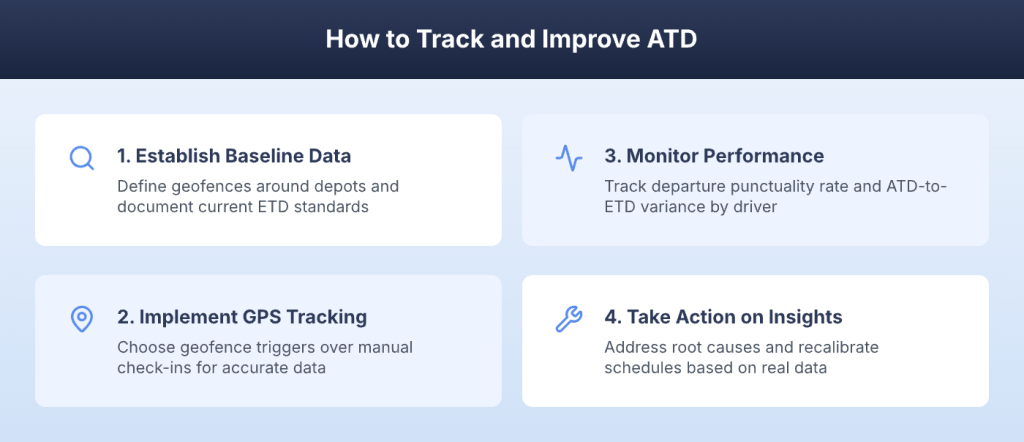
Tracking ATD effectively requires more than recording timestamps. Fleet managers need a structured approach that combines the right technology, clear processes, and continuous measurement to turn departure data into operational improvement.
Step 1: Establish Baseline Departure Data
Before making changes, you need to understand where your fleet stands today. Baseline data reveals patterns and sets realistic targets for improvement.
Define Departure Points and Geofences
Set geofence boundaries around depots, warehouses, and pickup locations. Configure the system to record ATD when a vehicle exits the defined zone. Ensure GPS update frequency is sufficient, as modern systems update vehicle location every 10 to 30 seconds with high accuracy. Fleet geofencing is the foundation of automated departure tracking.
Document Current ETD Standards
Record planned departure times for every route and shift. Establish what “on-time departure” means for your operation, for example, within five minutes of the scheduled ETD. Create a departure punctuality baseline before implementing changes so you can measure the impact of improvements.
Step 2: Implement GPS-Based Departure Tracking
With baseline data established, the next step is choosing and configuring the right tracking method for your fleet.
Choose Geofence vs Manual Check-In
Geofence triggers are automatic, require no driver action, and eliminate human error. Manual check-in requires the driver to mark departure in an app, which is simpler to set up but prone to delays and inaccuracy. For fleets prioritizing data quality, geofence-based tracking is the stronger choice, with manual check-in as a fallback.
Integrate With Route Scheduling
Connect departure tracking to your route scheduling system so ATD is automatically compared against the scheduled ETD for every route. Enable real-time alerts when departure exceeds the acceptable threshold. This integration turns raw timestamps into actionable departure variance data.
Step 3: Monitor and Measure Departure Performance
With tracking in place, the focus shifts to turning data into insights that guide fleet decisions.
Track Departure Punctuality Rate
The formula is straightforward: (On-time departures / Total departures) x 100. Best-in-class fleets target 95% or higher on-time departure rates. Break this metric down by driver, depot, day of week, and route type to identify where performance lags.
Analyze ATD-to-ETD Variance
Calculate the average departure variance across the fleet. Look for patterns. Are Monday mornings consistently late? Is one depot always behind? Use trend data to distinguish systemic issues from one-off delays. Driver tracking data paired with ATD variance analysis reveals root causes that aggregate numbers alone cannot surface.
Step 4: Take Action on Departure Insights
Data without action is just overhead. This step turns departure analytics into operational changes that reduce late departures.
Address Root Causes of Late Departures
Common causes include slow loading processes, driver tardiness, incomplete route preparation, and vehicle issues. Match the fix to the cause. Loading delays need warehouse process changes, not driver discipline. Vehicle-related delays require pre-trip inspection checklists and proactive maintenance scheduling.
Recalibrate Schedules Based on Real Data
If ATD consistently runs 10 minutes late at a specific depot, adjust the ETD accordingly or fix the underlying process bottleneck. Use historical ATD data to set realistic departure windows rather than aspirational targets. Build buffer time into routes with chronic departure variability so downstream ETAs remain accurate.
With a structured tracking system in place, the next challenge is overcoming the common obstacles that prevent fleets from maintaining departure accuracy at scale.
See it in action
Deliver Orders More Predictably with Upper
Accurate delivery timing starts with better planning. Optimize routes, reduce delays, and provide customers with reliable delivery updates throughout the day.
Common Challenges With ATD Tracking
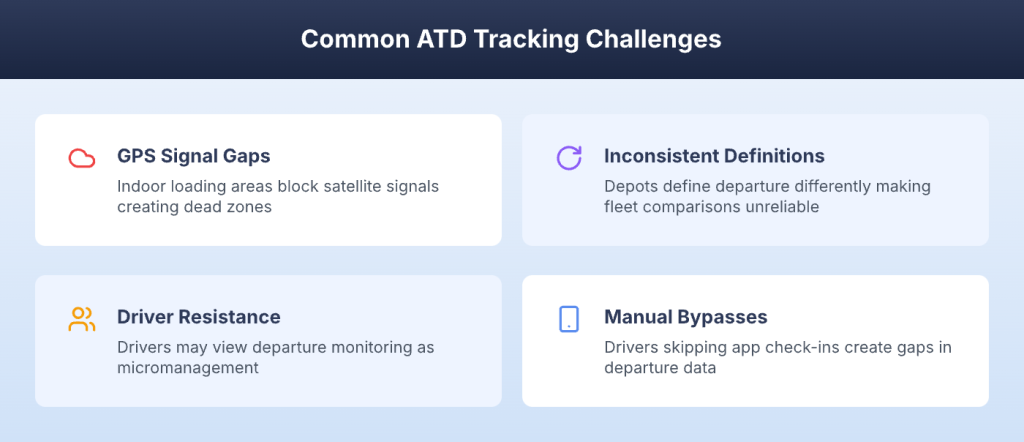
Even with the right tools in place, fleet managers encounter practical challenges that undermine ATD accuracy. Recognizing these obstacles early prevents wasted investment and operational frustration.
GPS Signal Gaps in Indoor Loading Areas
Vehicles inside warehouses or covered docks may not register geofence exits accurately due to GPS signal obstruction. Concrete and steel structures block satellite signals, creating dead zones where departure events go unrecorded.
Solution: Place geofence boundaries at the facility exit point, not the loading bay. This ensures the vehicle has a clear GPS signal when it crosses the departure threshold.
Driver Resistance to Departure Monitoring
Drivers may view ATD tracking as micromanagement, especially if the data is only used to flag late departures. This resistance can lead to workarounds that compromise data quality.
Solution: Frame departure tracking as a tool that protects drivers. Accurate ATD records prove they left on time when delays happen downstream. When drivers disable GPS tracking, it often signals a communication gap, not a technology problem.
Inconsistent Departure Definitions Across Depots
One depot counts “loaded and moving” as departure while another counts “gate exit.” This inconsistency makes fleet-wide comparisons unreliable and masks performance issues at individual locations.
Solution: Standardize the departure event definition across all locations. Document exactly what constitutes a “departure” and train all dispatchers and depot managers on the same standard.
Manual Processes That Bypass Automated Tracking
Drivers who skip app check-ins or leave before the system registers their departure create gaps in the data. Partial data is often worse than no data because it creates a false sense of accuracy.
Solution: Rely on passive geofence triggers rather than manual actions. Automated tracking removes the human variable entirely and ensures every departure is captured regardless of driver behavior.
These challenges are solvable with clear process standards and the right technology stack. The following best practices help fleets maintain high ATD accuracy over time.
6 Best Practices for Improving ATD Accuracy
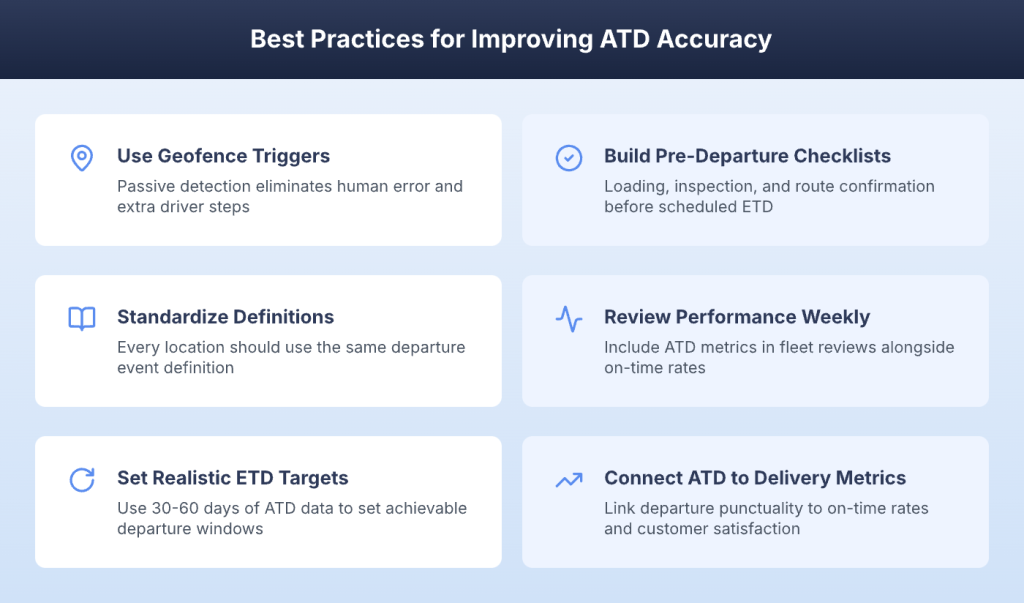
Improving ATD accuracy requires a combination of technology configuration, process discipline, and team alignment. These six best practices address the most common gaps in fleet departure tracking.
1. Use Geofence-Based Triggers Over Manual Check-Ins
Passive detection eliminates human error and removes an extra step for drivers. Configure the geofence radius appropriately. Too large captures parking lot movement as false departures, and too small misses legitimate exits.
2. Standardize Departure Definitions Across All Locations
Document exactly what constitutes a “departure” for your fleet. Whether it is a vehicle exiting the facility geofence or clearing the main gate, every location should use the same definition to ensure consistent measurement.
3. Set Realistic ETD Targets Based on Historical ATD Data
Use 30 to 60 days of ATD data to set achievable departure windows. Avoid aspirational ETDs that drivers consistently miss. Inflated targets hide real issues and make variance analysis unreliable.
4. Build Pre-Departure Checklists Into Driver Workflows
Loading verification, vehicle inspection, and route confirmation should happen before the scheduled departure time. A structured pre-departure process reduces delays caused by forgotten items, vehicle issues, or last-minute route questions.
5. Review Departure Performance Weekly
Include ATD metrics in weekly fleet performance reviews alongside fleet performance metrics like on-time rates and route efficiency. Recognize top-performing drivers and address chronic issues with specific, data-backed coaching.
6. Connect ATD Data to Downstream Delivery Metrics
Link departure punctuality to on-time delivery rates, customer satisfaction scores, and ETA accuracy. When the team sees how their departure time directly impacts the end-customer experience, accountability shifts from compliance to ownership. Learning how to evaluate delivery driver performance with departure data gives managers a complete picture of driver effectiveness.
When these practices are embedded into daily operations, ATD becomes more than a timestamp. It becomes a lever for continuous improvement across the entire delivery chain.
See it in action
Ready to Implement These Best Practices?
Upper's fleet tracking and route scheduling tools give you geofence-based departure monitoring, real-time departure alerts, and weekly performance reports, all without manual driver check-ins.
Track Actual Departure Times Accurately With Upper
ATD is the foundation of fleet visibility. Without it, dispatchers are reacting to delays after they cascade, customers receive inaccurate ETAs, and departure performance stays invisible. With a structured tracking approach, departure data becomes a tool for continuous fleet improvement.
Upper‘s real-time GPS tracking records precise departure timestamps through geofence triggers, with no manual driver check-ins required. Route scheduling features let dispatchers set planned departure times for every driver and route, creating the ETD baseline that ATD is measured against. Smart analytics surfaces departure punctuality trends by driver, depot, and route, turning raw timestamps into actionable fleet intelligence.
Automated customer notifications recalculate ETAs based on actual departure times, so customers always receive accurate arrival windows even when a driver leaves late. Driver dispatch management coordinates route assignments and departure sequences, reducing idle time at the depot and getting drivers on the road faster.
Fleet managers who want to stop guessing when drivers leave and start measuring departure performance with precision can book a demo to see how Upper handles ATD tracking across their entire operation.
FAQs on Actual Delivery Time
ETD (Estimated Time of Departure) is the planned or scheduled departure time set before the trip begins. ATD (Actual Time of Departure) is the real timestamp recorded after the vehicle departs. The gap between ETD and ATD, called departure variance, measures how punctually a fleet executes its scheduled routes.
Most delivery companies track ATD using GPS-based geofence triggers. When a vehicle exits a defined zone around a depot or warehouse, the system automatically logs the departure timestamp. Some operations use manual driver check-ins through a mobile app, though geofence-based tracking is more accurate and requires no driver action.
ATD is the starting point for every downstream delivery calculation. When a driver departs late, ETAs shift, delivery windows are missed, and customer satisfaction drops. Tracking ATD allows dispatchers to detect late departures in real time and adjust routes or notify customers before delays compound across the entire route.
Best-in-class delivery fleets target a 95% or higher departure punctuality rate, meaning 95 out of 100 departures happen within the acceptable window of the scheduled ETD. Most fleets start in the 80 to 85% range and improve through consistent measurement, geofence-based tracking, and process standardization.
Yes. Late departures cascade into overtime, missed delivery windows, redelivery attempts, and customer complaints, all of which increase operating costs. Fleets that track ATD and address departure delays typically see improvements in route completion rates, fuel efficiency, and driver productivity.
Accurate ATD tracking requires three components: GPS tracking with geofence capabilities to record departure events automatically, route scheduling software to establish planned ETDs as a comparison baseline, and analytics dashboards to measure departure variance and identify improvement opportunities over time.



: Meaning, Tracking, and Fleet Best Practices)