
The cannabis industry has experienced rapid growth over the past few years, and delivery services have become a major part of that expansion. As more regions legalize medical and recreational cannabis, customers increasingly expect fast, convenient, and discreet delivery options similar to other on-demand services. This growing demand is creating major opportunities for entrepreneurs entering the cannabis delivery market.
The market’s projected growth highlights the scale of this opportunity. According to Business Research Insights, the global Cannabis Delivery Service Market is expected to grow from USD 137.7 billion in 2026 to USD 1,922 billion by 2035. As demand for convenient cannabis access continues to increase, delivery businesses are becoming a critical part of the industry’s future.
However, starting a cannabis delivery business involves more than simply transporting products from one location to another. Business owners must navigate licensing requirements, compliance regulations, delivery tracking, age verification, and operational logistics while maintaining a reliable customer experience.
From building compliant delivery workflows to optimizing routes and managing drivers efficiently, this guide will walk through how to start a cannabis delivery business, the legal and operational requirements involved, and the tools needed to run efficient cannabis delivery operations.
Table of Contents
- Cannabis Delivery Business Overview
- How to Start a Cannabis Delivery Business in 6 Steps
- Common Challenges in Cannabis Delivery Operations
- Best Practices for Running a Compliant Cannabis Delivery Business
- Technology Stack for Cannabis Delivery Operations
- Launch Your Cannabis Delivery Operations With Upper
- Frequently Asked Questions
Cannabis Delivery Business Overview
A cannabis delivery business provides customers with legal cannabis products through scheduled or on-demand delivery services. These businesses typically operate by partnering with licensed dispensaries or by running their own licensed retail operations, depending on local regulations. Customers place orders online or through mobile apps, and delivery drivers transport products directly to verified customers while following strict compliance and security guidelines.
The cannabis delivery industry has grown rapidly as consumers increasingly prefer the convenience, privacy, and accessibility of home delivery. Similar to food and grocery delivery models, cannabis delivery businesses rely heavily on efficient dispatching, route optimization, driver management, and real-time tracking to maintain fast and reliable service.
Three Cannabis Delivery Business Models
Hub-and-spoke (pizza shop model): A central dispensary location receives, packages, labels, and dispatches orders. This is the most common model for licensed dispensaries adding delivery to existing operations.
Non-storefront/warehouse-on-wheels (ice cream model): Drivers carry pre-packed inventory and make multiple deliveries along dynamic routes. Lower overhead, but requires a specific non-storefront license in most states.
Hybrid model: Combines central dispatch with mobile inventory for high-demand zones. Offers operational flexibility but adds compliance complexity since inventory tracking spans both fixed and mobile locations.
With the market trajectory and expanding legal framework established, the next step is understanding exactly what it takes to launch.
How to Start a Cannabis Delivery Business in 6 Steps
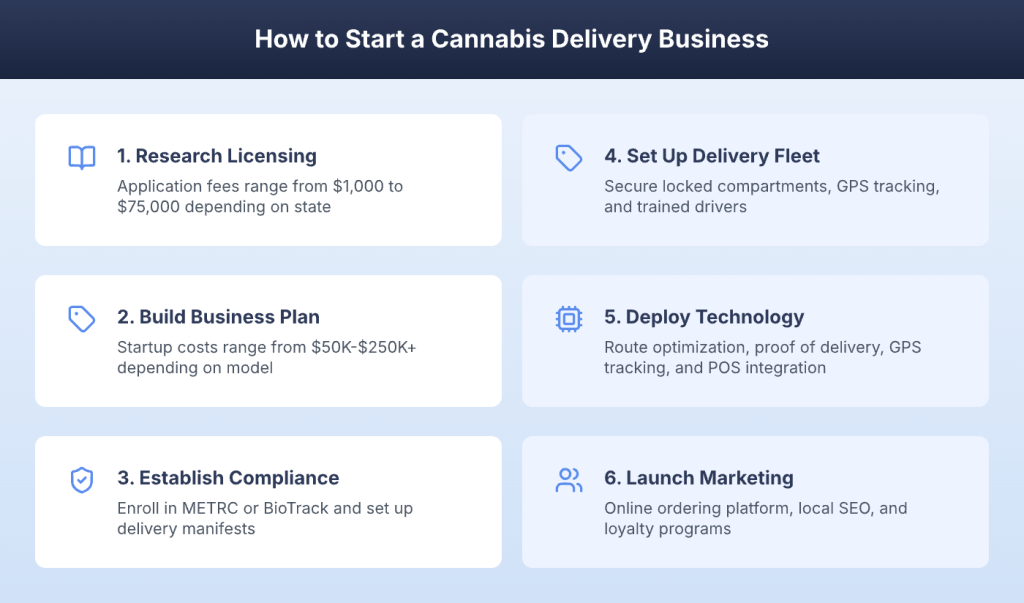
Launching a cannabis delivery service requires parallel planning across licensing, business strategy, compliance, fleet operations, and technology. The six steps below follow the operational sequence most successful operators use. Some steps, particularly business planning and license research, should happen simultaneously.
Step 1: Research Licensing Requirements in Your State
Identify Your License Type
Cannabis delivery licenses vary significantly by state. The three primary categories are delivery-only (courier) licenses, non-storefront retailer licenses, and dispensary delivery endorsements added to existing retail licenses.
California’s Department of Cannabis Control (DCC), New York’s Office of Cannabis Management (OCM), Colorado’s Marijuana Enforcement Division (MED), and Michigan’s Cannabis Regulatory Agency (CRA) each administer their own licensing frameworks.
Some states, like Oklahoma, allow medical dispensaries to add delivery after specific waiting periods. Researching your state’s specific license types is the critical first step before any other planning begins.
Understand Application Requirements and Costs
Application fees range from $1,000 in New York (non-refundable) to $5,000 or more depending on state and license type. New York’s delivery endorsement adds $4,500 to retail license fees, while a standard adult-use retail license costs $1,000 to apply, plus $7,000 for a two-year term. California’s annual license fees range from $2,500 to $120,000 based on gross revenue tier. Most states require background checks, financial disclosures, security plans, and detailed operating plans as part of the application. If you are considering New York specifically, this guide on how to start a cannabis delivery service in New York covers the state’s requirements in detail.
Check Local Zoning and Distance Requirements
Cannabis facilities must operate in commercial or industrial zones in most jurisdictions. Required distances from schools, parks, and churches range from 200 to 1,000 feet, depending on the municipality.
Some cities maintain local bans on cannabis delivery even in legal states, so verifying city and county regulations is essential before signing a lease or submitting a license application. Route planning must also account for cannabis delivery through restricted zones to avoid compliance violations during transport.
Step 2: Build a Cannabis Delivery Business Plan
Define Your Business Model and Target Market
Choose between the hub-and-spoke, non-storefront, or hybrid delivery models outlined above. Define your delivery radius, target demographics, and product mix based on local demand. Analyze existing competition in your market: how many dispensaries already offer delivery, are there delivery-only operators, and what gaps exist in service quality or coverage?
Project Startup Costs and Revenue
Total startup costs for a cannabis delivery business typically range from $50,000 to $250,000 or more, depending on state, license type, and operating model. Major cost categories include licensing ($5,000 to $75,000), vehicles ($25,000 to $40,000 per van), insurance ($5,000 to $15,000 per year), technology ($200 to $500 per month), and initial inventory ($10,000 to $50,000).
Average order values in cannabis delivery range from $60 to $120. Build a break-even analysis based on projected delivery volume, average ticket, and fixed operating costs.
Secure Funding
Cannabis businesses face unique funding challenges because federal illegality limits traditional banking and SBA loans. Common funding sources include private investors, cannabis-focused venture capital firms, and state social equity programs designed to support minority and community-impacted applicants.
A detailed business plan that demonstrates compliance viability is critical for attracting investment. For additional cannabis delivery business statistics to support your projections, review industry benchmarks before finalizing financial models.
Step 3: Establish Compliance and Tracking Systems
Enroll in State Track-and-Trace Systems
METRC is the most common state-mandated tracking system, used in California, Colorado, Oregon, Massachusetts, and other states. BioTrack and Leaf Data are used in select states. Every cannabis product must be tracked from cultivation through delivery to the end consumer, and your delivery operation must integrate with the applicable system. Understanding METRC integration for delivery workflows is essential before your first trip leaves the facility.
Set Up Delivery Manifest Documentation
State regulations require manifests for every delivery trip. These manifests must include driver name, employee ID, driver’s license number, vehicle make, model, and plate number, along with a complete product inventory for the trip.
Manifests must be available for inspection at any time during transport. Digital manifest systems reduce errors and ensure real-time compliance. Capturing cannabis proof of delivery at every stop creates the documentation chain regulators require.
Implement Age and Identity Verification
Every cannabis delivery requires age verification at the point of handoff: 21 and older for adult-use, 18 and older for medical with a valid card. ID scanning technology at the door is becoming the industry standard. Verification records must be documented in your delivery confirmation system to protect against regulatory challenges.
Step 4: Set Up Your Delivery Fleet
Choose and Equip Delivery Vehicles
Vehicles need secure, locked compartments for cannabis transport, as required by state law. GPS tracking is mandated in most states, with Colorado, Massachusetts, and Michigan requiring it specifically. Some jurisdictions require unmarked vehicles for security. Factor in fuel efficiency and maintenance costs when selecting vehicles for daily delivery routes.
Hire and Train Delivery Drivers
Drivers must hold valid marijuana handler permits in most states. Colorado, for example, requires this specifically. Background checks are universal. Training must cover product handling, age verification, compliance documentation, safe transport procedures, and customer interaction protocols. A structured delivery driver training program reduces compliance risk and accelerates onboarding for new hires.
Design Delivery Zones and Service Areas
Map delivery zones based on license restrictions, customer density, and drive time. Account for restricted areas near schools, parks, and government buildings that drivers must avoid during transport.
Route efficiency within zones directly impacts profitability and daily delivery capacity. Setting up defined delivery zones early in your planning prevents operational bottlenecks as order volume grows.
Step 5: Deploy Delivery Technology
Route Optimization Software
Cannabis delivery adds routing complexity that general-purpose tools cannot handle: restricted zone avoidance, time-window compliance, and chain-of-custody tracking requirements. Route optimization reduces fuel costs by 20 to 30% and increases daily delivery capacity by sequencing stops efficiently across the fleet. Some of the best cannabis delivery software solutions ensure balanced workloads so no single driver is overburdened while others sit idle.
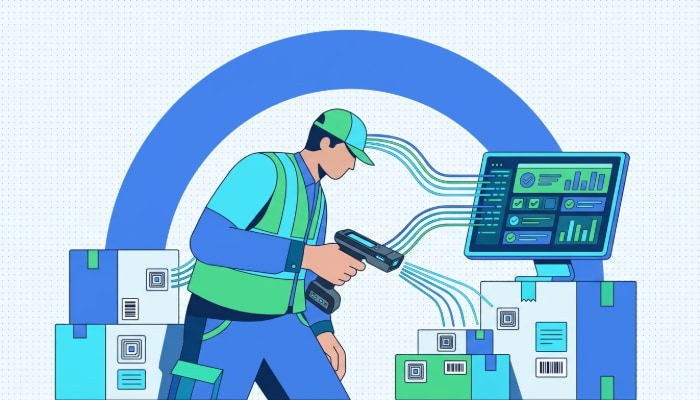
Proof of Delivery and Chain of Custody Documentation
Digital proof of delivery, including photos, signatures, and timestamps, satisfies the compliance requirements cannabis regulators enforce. Geotagged proof of delivery creates verifiable location records for every delivery, proving the handoff occurred at the correct address.
This chain-of-custody documentation protects against regulatory violations and customer disputes. Upper captures multi-photo proof of delivery with GPS coordinates and customer signatures at every stop.
GPS Tracking and Customer Notifications
Real-time GPS tracking meets state-mandated vehicle tracking requirements while giving dispatchers full visibility into fleet operations. Customer notifications with delivery ETAs reduce inbound support calls and create a professional delivery experience. Automated status updates via SMS keep customers informed without requiring drivers to make manual calls.
For cannabis operators managing fleet driver accountability, GPS tracking also provides the driver performance data needed to identify and address inefficiencies.
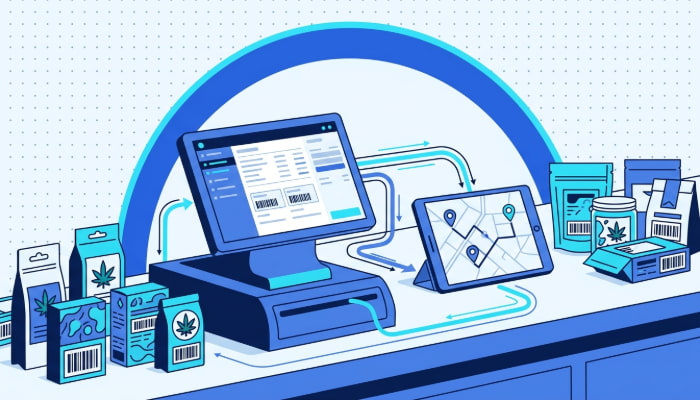
POS Integration
Connecting delivery software with your dispensary POS system automates order-to-route workflows and eliminates manual entry errors. Inventory updates in real time as deliveries are completed, keeping your track-and-trace system accurate.
Seamless cannabis delivery POS integration reduces the gap between order placement and dispatch.
Step 6: Launch Marketing and Customer Acquisition
Build Your Online Ordering Platform
A cannabis-compliant e-commerce platform requires age-gate verification, a product catalog with THC and CBD content details, and a delivery zone checker that confirms service availability before checkout.
Mobile-first design is essential since the majority of cannabis orders originate from mobile devices. Integrate with cannabis delivery marketplaces like Weedmaps and Leafly for early customer discovery.
Local SEO and Digital Marketing
Google Business Profile optimization is permitted in most markets and should be a priority. Cannabis advertising restrictions limit paid channels: Google Ads prohibits cannabis promotion, and Meta and Instagram have strict limitations.
Focus on organic search, email marketing, and content strategies such as strain guides, product education, and local delivery area pages. SMS marketing for order updates and promotions must comply with TCPA regulations.
Customer Retention Strategies
Loyalty programs and repeat order incentives keep customers coming back. Consistent delivery experience, meaning on-time, professional, and compliant, is the strongest retention tool. Automated delivery notifications build trust and encourage reorders by keeping customers informed throughout the process.
With the launch framework in place, understanding the challenges that trip up new operators separates businesses that survive from those that scale.

See it in action
Plan Compliant Cannabis Routes Around Restricted Zones
Upper's route optimization builds delivery routes that respect geographic restrictions, school zones, and jurisdiction boundaries automatically.

Common Challenges in Cannabis Delivery Operations
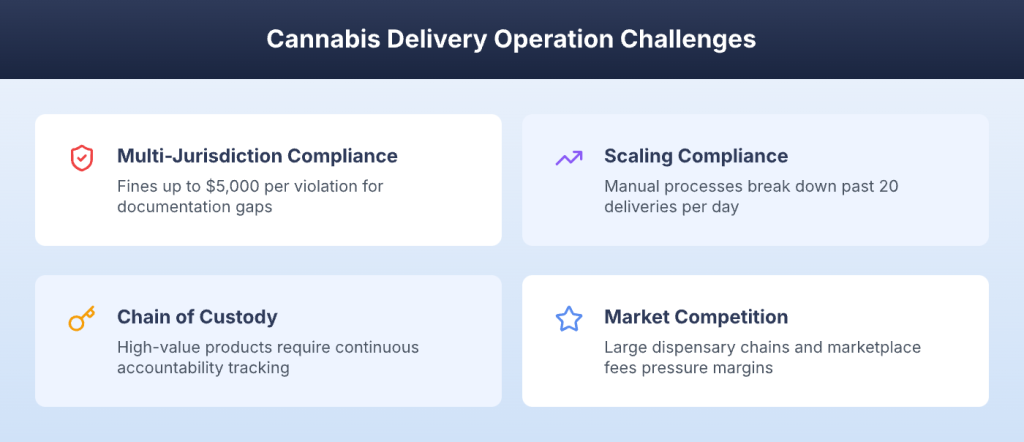
Launching a cannabis delivery business is only the beginning. Ongoing operations present challenges that require proactive management and the right technology infrastructure. Here are the four most common obstacles operators face and how to address them.
Navigating Multi-Jurisdiction Compliance
State regulations change frequently, and operators must monitor updates from cannabis control boards continuously. Local municipalities can impose additional restrictions on top of state rules. California’s DCC imposes fines up to $5,000 per violation for licensed operators and $30,000 for unlicensed activity. A single delivery trip with multiple documentation gaps can generate tens of thousands in penalties.
Solution: Implement digital compliance systems that automatically generate manifests, capture proof of delivery, and maintain GPS records for every trip. Automated documentation eliminates the manual errors that trigger violations.
Managing Driver Accountability and Chain of Custody
Cannabis products are high-value targets, making driver accountability both a security and compliance issue. GPS tracking, proof of delivery, and manifest documentation create a continuous chain of custody from dispatch to handoff. Driver turnover in delivery is high, so training and onboarding must be systematized and repeatable.
Solution: Deploy GPS tracking and digital proof of delivery to create a verifiable chain of custody for every delivery. Standardize driver onboarding with compliance-focused training modules that cover documentation requirements from day one.
Scaling Delivery Volume Without Losing Compliance
Manual processes like paper manifests and phone-based dispatch break down as order volume grows. What works at 20 deliveries per day collapses at 100. Route optimization becomes critical when scaling because manual route planning cannot maintain efficiency or compliance at higher volumes. Operators who wait to implement technology often face the hardest transition when they are already overwhelmed.
Solution: Adopt route optimization and automated dispatch before scaling pressure hits. Technology that automates compliance documentation scales with the business. Learn more about how to scale last-mile delivery operations without proportionally increasing overhead.
Competing With Established Dispensaries and Marketplaces
Large dispensary chains adding delivery create competitive pressure on delivery-only operators. Marketplace platforms like Weedmaps and Leafly take significant commission fees that eat into margins. Differentiation comes from delivery speed, reliability, and customer experience, not from product selection alone.
Solution: Build operational efficiency through route optimization and automated dispatch. Faster delivery times, professional customer notifications, and consistent on-time performance create the competitive advantage that marketplace listings cannot replicate.
Operators who build compliance and efficiency into their technology stack from day one avoid the most common failure points.
See it in action
Capture Photo and Signature Proof of Delivery for Every Drop-Off
Upper's digital proof of delivery creates an auditable compliance record at each stop with timestamped photos, signatures, and delivery notes.
Best Practices for Running a Compliant Cannabis Delivery Business
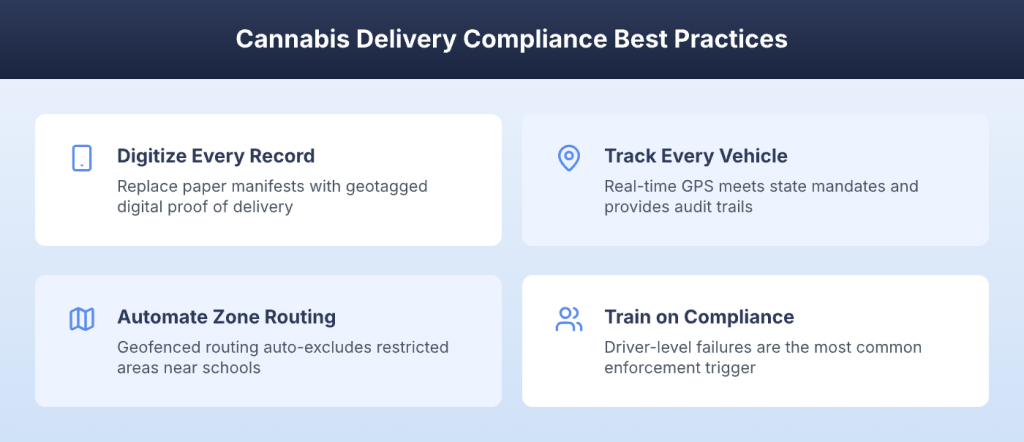
The difference between operators who face enforcement actions and those who pass audits cleanly comes down to process discipline. These four best practices create the compliance foundation that protects your license and your business.
Digitize Every Delivery Record
Replace paper manifests and handwritten signatures with digital proof of delivery. Geotagged photos and timestamps create audit-ready records that are searchable, shareable with regulators on demand, and impossible to lose.
Digital records stored in the cloud eliminate the risk of damaged or misplaced paperwork. Review this guide on how to collect electronic proof of delivery to set up your documentation workflow.
Automate Route Planning Around Restricted Zones
Manual route planning cannot reliably avoid restricted areas near schools, parks, and government buildings, especially as your delivery territory expands. Geofenced route optimization automatically excludes prohibited delivery areas from route calculations. This saves time on daily route planning while eliminating the compliance risk of drivers inadvertently passing through restricted zones.
Track Every Vehicle in Real Time
State regulations in Colorado, Massachusetts, Michigan, and others mandate GPS tracking for cannabis delivery vehicles. Real-time tracking gives dispatchers visibility to respond to delays, reroute drivers, and address issues as they happen. GPS breadcrumb trails provide evidence of route compliance if your operation is audited.
Train Drivers on Compliance as Much as Delivery
Every driver should understand age verification procedures, manifest requirements, product handling protocols, and incident reporting processes. Regular training refreshers are necessary as regulations update. Compliance failures at the driver level are the most common enforcement triggers in cannabis delivery.
Technology is the enabler that turns best practices into daily habits. The right delivery management platform handles compliance documentation, route optimization, and fleet tracking in a single system.
Technology Stack for Cannabis Delivery Operations
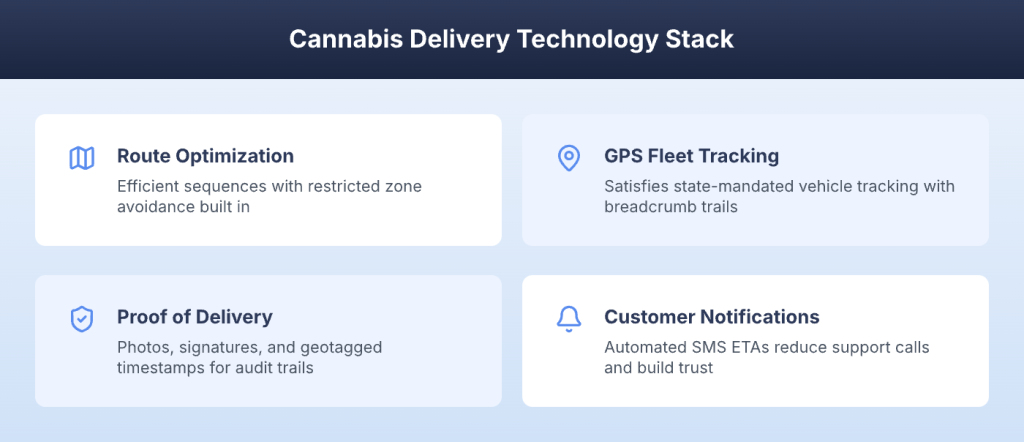
Cannabis delivery requires a more comprehensive technology stack than general delivery operations because of the regulatory layer. Each technology category maps to both an operational need and a compliance requirement. Here are the four core components every cannabis delivery operation needs.
Route Optimization and Delivery Zone Management
Route optimization software calculates efficient delivery sequences across zones while respecting restricted areas that cannabis vehicles must avoid. It reduces fuel costs and increases stops per driver per shift. Multi-driver optimization balances workload across the fleet so dispatch is efficient and equitable.
Proof of Delivery and Compliance Documentation
Photos, signatures, timestamps, and geotagged location data captured at every stop create the compliance audit trail regulators require. Digital proof of delivery reduces delivery disputes and chargeback claims while providing the documentation needed for regulatory inspections.
GPS Tracking and Fleet Visibility
Real-time GPS tracking satisfies state-mandated vehicle tracking requirements and provides dispatchers with live fleet visibility. Driver breadcrumb trails document route compliance, showing exactly where vehicles traveled during every delivery run.
Customer Notifications and Delivery Updates
Automated SMS and email notifications with delivery ETAs reduce inbound support calls and build customer trust. Delivery confirmation messages encourage repeat orders by creating a professional, transparent experience.
The right technology stack turns compliance from a burden into an automated background process. With route optimization, proof of delivery, GPS tracking, and customer notifications working together, operators can focus on growing the business instead of managing paperwork.
See it in action
Dispatch Optimized Routes to Drivers With One Click Using Upper
Upper handles route optimization, dispatch, GPS tracking, and proof of delivery in one platform built for compliance-heavy delivery operations.
Launch Your Cannabis Delivery Operations With Upper
Starting a cannabis delivery business requires navigating licensing, compliance systems, fleet setup, and technology decisions simultaneously. The operators who succeed are the ones who build compliance and operational efficiency into their foundation from day one, rather than retrofitting systems after problems surface.
Upper is built for the specific demands of cannabis delivery operations. Route optimization handles restricted zone avoidance automatically, ensuring drivers never route through prohibited areas near schools, parks, or government buildings.
For cannabis operators, Upper replaces the patchwork of disconnected tools that create compliance gaps. Route optimization, proof of delivery, GPS tracking, and automated customer notifications work together in a single platform. That means fewer manual processes, fewer documentation errors, and a technology stack that scales as delivery volume grows.
Whether you are launching a new cannabis delivery service or adding delivery to an existing dispensary, Upper provides the operational backbone to stay compliant and grow profitably. Book a demo to see how Upper handles cannabis delivery route planning, compliance documentation, and fleet management in one platform.
Frequently Asked Questions
Requirements vary by state, but the three primary license types are delivery-only (courier) licenses, non-storefront retailer licenses, and dispensary delivery endorsements. Application fees range from $1,000 to $75,000, depending on state and license type. Most states require background checks, security plans, financial disclosures, and detailed operating plans as part of the application process.
Total startup costs range from $50,000 to $250,000 or more, depending on state, license type, and delivery model. Major cost categories include licensing ($5,000 to $75,000), vehicles ($25,000 to $40,000 per van), insurance ($5,000 to $15,000 per year), technology ($200 to $500 per month), and initial inventory ($10,000 to $50,000).
California, Colorado, New York, Massachusetts, Michigan, Oregon, and several others have active cannabis delivery programs. Legalization continues to expand, with seven or more states considering new legislation in 2026. Each state has its own licensing framework, so operators must research the specific requirements for their target market.
A cannabis courier only transports products from licensed dispensaries to customers and does not take ownership of inventory. A non-storefront retailer purchases, stores, and delivers products directly to consumers without a physical retail storefront. License requirements, costs, and operational models differ significantly between the two categories.
Compliance requires enrollment in state track-and-trace systems like METRC or BioTrack, delivery manifests for every trip, age verification at the point of delivery, GPS tracking of all vehicles, digital proof of delivery documentation, driver training on handling and documentation protocols, and route planning that avoids restricted zones.
Cannabis delivery operations require route optimization software for efficient multi-stop routing and restricted zone avoidance, proof of delivery systems for compliance documentation, GPS fleet tracking for state-mandated vehicle monitoring, customer notification tools for delivery updates, and POS integration for order-to-route automation. Upper covers route optimization, proof of delivery, GPS tracking, and customer notifications in a single platform.
Yes, in states that offer delivery-only or non-storefront licenses. California and New York both allow operators to launch delivery services without a retail storefront. These operators purchase cannabis products from licensed distributors and deliver directly to customers. License requirements and costs for non-storefront operations are typically lower than full retail dispensary licenses.